
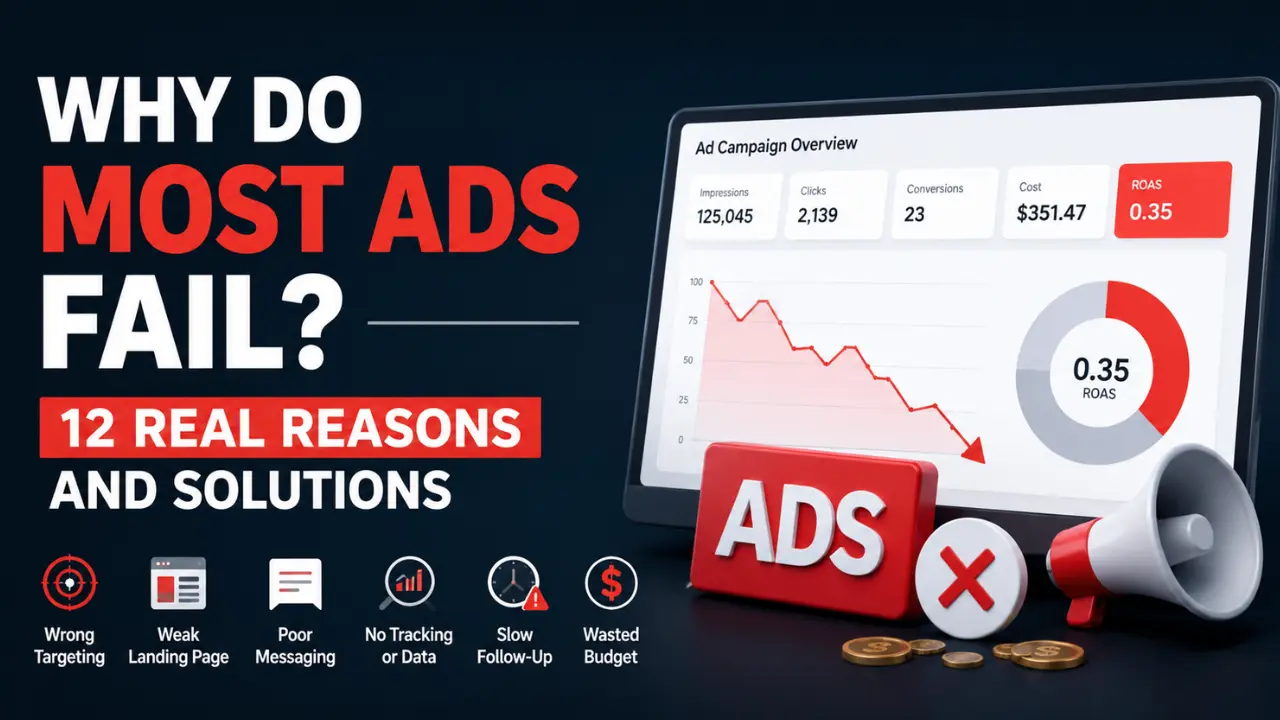

Most ads fail because business owners expect the ad platform to fix problems that actually exist in the offer, audience targeting, landing page, message, budget, tracking, or sales process. A paid ad can bring attention to a business, but it cannot automatically create trust, fix a weak offer, convince the wrong audience, or turn a confusing website into a high-converting sales system.
For many small businesses, the problem is not always that Google Ads, Facebook Ads, Instagram Ads, or YouTube Ads “do not work.” The deeper issue is that the ad is launched before the business has a clear answer to four simple questions: who is the ad for, what problem does it solve, why should someone choose this business now, and what should happen after the click?
When those answers are weak, the campaign spends money without building momentum. The ad may get impressions, clicks, and even website visits, but it does not produce enough calls, leads, bookings, purchases, or appointments to justify the cost.
Most Ads Fail Before the Campaign Even Starts
Many ads fail before the first dollar is spent because the campaign is built on a weak foundation. The business owner may choose a platform, write a quick headline, set a daily budget, and hope the algorithm finds customers. That approach sounds easy, but it skips the most important part of advertising: strategic clarity.
A paid ad is not just a traffic button. It is a business message placed in front of a specific audience with the goal of creating a specific action. If the message is unclear, the audience is too broad, or the offer does not feel valuable, the campaign starts with a built-in disadvantage.
For example, a local service business may run an ad saying “Best Plumbing Services Near You.” That may sound normal, but it does not explain why someone should click that business instead of the other plumbers appearing in search results. A better campaign would focus on a real customer need, such as emergency response, leak detection, water heater repair, transparent pricing, same-day appointments, or a specific city-based service.
The difference is not just wording. The difference is intent. One ad is generic, while the other connects directly to a problem the customer already has.
Many campaigns fail because they are launched without a proper setup process, so beginners should first understand the basic structure of a campaign through a step-by-step guide like 7 Steps to Set Up a Google AdWords Campaign.
Offer Is Too Weak or Too Generic
One of the biggest reasons ads fail is that the offer does not give the customer a strong enough reason to take action. Many small businesses advertise their service, but they do not present a clear value proposition.
A value proposition answers the customer’s silent question: “Why should I choose this business instead of another one?”
A weak offer usually sounds like every competitor. It uses phrases such as “quality service,” “affordable prices,” “trusted experts,” or “professional solutions.” These words are not always wrong, but they are too common to create real urgency or distinction. Customers see these phrases everywhere, so they stop paying attention to them.
A stronger offer is more specific. It may include faster service, a clear process, a free estimate, a limited-time inspection, a guarantee, a first-time customer discount, a niche specialization, or a promise tied to a real customer pain point.
For example:
| Weak Ad Message | Stronger Ad Message |
|---|---|
| Affordable HVAC repair | Same-day AC repair for homes with weak cooling |
| Best digital marketing agency | Google Ads setup for local service businesses that need calls |
| Quality cleaning service | Move-out cleaning with checklist-based room inspection |
| Professional dentist near me | Emergency dental appointments available for tooth pain |
The stronger message does not only say what the business does. It shows why the service matters to the customer right now.
Ad Targets the Wrong Audience
Ads fail when they reach people who are unlikely to buy, book, call, or request a quote. A campaign can have thousands of impressions and still fail if those impressions come from the wrong people.
This happens often when businesses target too broadly. They may select a wide location, a large age range, broad interests, or loose keywords. The platform then tries to find people inside that wide audience, but not all attention is valuable attention.
For Google Ads, wrong targeting often happens through poor keyword selection. A business may bid on broad terms that attract information seekers instead of buyers. For example, a company selling payroll services may waste money on people searching “what is payroll” instead of targeting phrases such as “payroll service for small business” or “outsourced payroll provider near me.”
For Facebook and Instagram Ads, wrong targeting often happens when businesses depend too much on interests without understanding buyer readiness. A person may be interested in fitness, home decor, or business content, but that does not mean they are ready to buy a product, book a service, or request a consultation today.
The best ads do not just chase attention. They match the ad to the buyer’s stage of awareness.
Campaign Ignores Search Intent
Search intent is the reason behind a person’s search. If an ad does not match that reason, the campaign will usually perform poorly even if the keyword looks valuable.
Someone searching “how to advertise my business on Google” may want a guide, tutorial, or beginner explanation. Someone searching “Google Ads agency for small business” is much closer to hiring help. Someone searching “emergency roof repair near me” needs urgent service and may call quickly if the business looks trustworthy.
These searches require different ads, different landing pages, and different calls to action.
A common mistake is sending every keyword to the same homepage. This weakens the campaign because the page does not fully match the user’s intent. A person searching for “commercial HVAC repair” should not land on a general homepage that talks about residential heating, maintenance plans, and company history before mentioning commercial service.
When search intent is strong, the landing page should continue that intent clearly. The page should confirm the service, location, problem, benefits, proof, and next step without making the visitor search for answers.
Landing Page Does Not Continue the Promise of the Ad
Many ads get clicks but fail after the click because the landing page does not match what the ad promised. This is one of the most expensive forms of ad failure because the business pays for attention and then loses the visitor at the moment they were interested.
The ad may promise one thing, while the page talks about something broader. The ad may mention a specific service, while the landing page opens with a generic company introduction. The ad may promote a free quote, but the page does not make the quote form easy to find.
A landing page should not feel disconnected from the ad. It should act like the next step in the same conversation.
A strong landing page usually includes:
- A clear headline that matches the ad and confirms the visitor is in the right place.
- A specific service explanation that answers what the business does and who it helps.
- Trust signals such as reviews, years of experience, guarantees, certifications, photos, or service areas.
- A simple call to action such as call now, request a quote, book an appointment, or schedule a consultation.
- Low friction so the visitor does not need to scroll too much, guess what to do, or fill out a long form.
If the ad creates interest but the landing page creates confusion, the campaign will lose money even when the traffic quality is good.
Ad Message Is Too Focused on the Business
Many ads fail because they talk too much about the business and not enough about the customer’s problem. Business owners often write ads from their own perspective. They mention their experience, services, company name, or product features, but they do not connect those details to what the customer wants.
Customers usually do not click because a business says it is professional. They click because they believe the business can solve a specific problem, reduce a risk, save time, remove stress, improve results, or help them make a better decision.
A customer-focused ad speaks to the need behind the service.
For example, instead of saying “We provide bookkeeping services,” a stronger message might say, “Bookkeeping help for small business owners who are tired of messy records before tax season.” The second message connects the service to a real frustration.
This is especially important for local businesses and service businesses. People are not only comparing prices. They are comparing confidence. The ad must make them feel that this business understands their situation better than the alternatives.
Budget Is Too Small for the Goal
Some ads fail because the budget is not realistic for the market. A small budget can work in some niches, but it must match the cost of reaching the right audience and collecting enough data.
If a business spends too little in a competitive industry, the campaign may not receive enough clicks or conversions to learn anything useful. The owner may stop the campaign after a few days because there are no results, but the campaign never had enough volume to prove whether the strategy was good or bad.
This is common in high-cost industries such as legal services, insurance, finance, home improvement, HVAC, plumbing, medical services, and B2B marketing. A few clicks may cost a lot, and one weak landing page can waste the entire daily budget.
A realistic budget does not mean spending blindly. It means understanding the gap between the cost of traffic and the value of a customer. A business that earns a high lifetime value from one client can often afford a higher cost per lead than a business selling a low-margin product.
The question is not only “How much does the ad cost?” The better question is “How much can the business afford to pay to acquire one serious customer?”
Campaign Has Poor Tracking
Ads fail when the business cannot accurately measure what is happening. Without tracking, the owner may judge the campaign by impressions, clicks, likes, or surface-level traffic. Those numbers can be useful, but they do not prove that the campaign is profitable.
A campaign should track meaningful actions. For a service business, that may include phone calls, form submissions, quote requests, bookings, direction clicks, or consultation requests. For an online business, it may include purchases, sign-ups, checkout starts, or lead magnet downloads.
Poor tracking creates two major problems. First, the business cannot tell which keywords, ads, audiences, or pages are producing real results. Second, the ad platform may optimize toward the wrong signals.
For example, if a business tracks page views as conversions, the platform may focus on people who visit the site but never become leads. If phone calls are not tracked, the owner may think the campaign failed even though it produced calls that were never properly attributed.
Good tracking does not make a bad offer successful, but it helps the business make smarter decisions before wasting more money.
Business Stops Testing Too Early
Many campaigns fail because the first version is treated as the final version. Advertising usually needs testing. The first ad may not have the best headline. The first landing page may not answer enough objections. The first audience may be too broad. The first offer may not create enough urgency.
A campaign should be improved based on real performance data. This includes testing different headlines, descriptions, landing pages, calls to action, offers, locations, keywords, audiences, and follow-up methods.
However, testing does not mean changing everything randomly every day. That creates confusion and prevents clear learning. Good testing is controlled. The business changes one important element at a time and watches whether the result improves.
For example, if an ad gets clicks but no leads, the issue may be the landing page, offer, trust signals, or form. If the ad gets impressions but no clicks, the issue may be the headline, keyword match, audience relevance, or visual creative. If the ad gets leads but no sales, the issue may be lead quality, pricing, sales follow-up, or response time.
Testing works best when the business knows what problem it is trying to diagnose.
Ad Looks Good but Does Not Build Trust
An ad can look polished and still fail if it does not build trust. This is especially true for services where the customer feels risk before buying. A homeowner hiring a contractor, a small business choosing a marketing agency, or a patient booking a clinic appointment wants more than a nice headline. They want confidence.
Trust can be built through specific proof. This may include customer reviews, before-and-after examples, case studies, clear pricing guidance, real photos, certifications, service guarantees, years in business, process explanations, and transparent expectations.
Many small businesses underuse proof. They expect the customer to believe the ad without showing enough evidence. In competitive markets, that is a serious weakness because the customer may compare several businesses before choosing one.
A strong ad does not need to say everything, but it should lead into a trustworthy experience. If the ad, landing page, reviews, Google Business Profile, and follow-up process all support the same promise, the customer feels safer taking action.
Call to Action Is Unclear or Too Demanding
Some ads fail because the call to action does not match the customer’s readiness. A person who is still comparing options may not be ready to “Buy Now.” A person with an urgent problem may not want to fill out a long form and wait two days for a reply.
The call to action should fit the situation.
For urgent local services, “Call Now” or “Book Same-Day Service” may work better. For expensive B2B services, “Schedule a Consultation” or “Request a Strategy Review” may feel more appropriate. For early-stage informational searches, “Get a Free Guide” or “See Pricing Options” may convert better than a direct sales pitch.
A weak call to action creates uncertainty. The visitor may like the business but not know what to do next. A demanding call to action creates resistance. The visitor may leave because the step feels too big too soon.
The best call to action makes the next step feel clear, useful, and low-risk.
Sales Follow-Up Is Too Slow
A campaign may produce leads and still fail because the business does not follow up fast enough. This is one of the most overlooked reasons ads lose money.
When someone fills out a form, requests a quote, or calls a business, their interest is often highest at that moment. If the business waits too long, the lead may contact another provider, lose interest, forget the request, or assume the company is not serious.
Fast follow-up matters especially for local services, home services, legal consultations, medical appointments, real estate, finance, and B2B inquiries. In these industries, a lead is not fully valuable until the business responds, qualifies the person, answers questions, and moves them toward the next step.
Ads do not replace sales discipline. They create opportunities. If those opportunities are not handled properly, the campaign may look weak even when the traffic was good.
Platform Gets Blamed for a Business System Problem
It is easy to blame the ad platform when a campaign fails. Sometimes the platform setup is truly the issue. The targeting may be wrong, the bid strategy may be poor, or the campaign may be optimized incorrectly. But in many cases, the platform only reveals weaknesses that already existed in the business system.
A weak website becomes more obvious when paid traffic arrives. A confusing offer becomes more expensive when every click costs money. Slow follow-up becomes more painful when leads are being purchased. Poor reviews become more damaging when customers compare the business before calling.
This is why successful advertising is not only about creating ads. It is about connecting the ad to the full customer journey.
That journey usually includes:
- The customer’s problem before they see the ad.
- The ad message that earns attention.
- The landing page that builds confidence.
- The call to action that makes the next step clear.
- The tracking system that measures real results.
- The follow-up process that turns interest into revenue.
If one part of this journey is weak, the entire campaign can suffer.
Signs Your Ads Are Failing for the Wrong Reason
Not every poor campaign has the same problem. The numbers usually give clues.
| Campaign Problem | What It Usually Means |
|---|---|
| High impressions but low clicks | The ad message, targeting, or offer may not be attractive enough. |
| Many clicks but no leads | The landing page, trust signals, offer, or call to action may be weak. |
| Leads but no sales | Lead quality, pricing, follow-up, or sales process may be the issue. |
| High cost per click | The niche may be competitive, or the campaign may need better keyword control. |
| Low-quality inquiries | Targeting, keyword intent, or ad wording may be attracting the wrong people. |
| People leave quickly | The page may not match the ad promise or may load too slowly. |
This kind of diagnosis is important because the wrong fix can waste more money. If the issue is the landing page, changing the ad headline alone will not solve it. If the issue is weak lead follow-up, increasing the budget will only produce more missed opportunities.
How to Make Ads Less Likely to Fail
The best way to reduce ad failure is to build the campaign around the customer’s real decision process. Before launching, the business should make sure the campaign has a clear audience, specific message, valuable offer, relevant landing page, realistic budget, proper tracking, and a follow-up system.
A business should ask these questions before spending money:
- Who exactly is this ad trying to reach?
- What problem is the customer dealing with right now?
- Is the offer specific enough to stand out?
- Does the landing page match the ad promise?
- Is the next step simple and visible?
- Are calls, forms, bookings, or purchases being tracked correctly?
- Can the business respond quickly when leads come in?
- Is the budget enough to collect useful data?
These questions prevent the business from treating ads like a gamble. They turn advertising into a controlled system that can be measured and improved.
Real Reason Most Ads Fail
Most ads fail because businesses launch campaigns before they build the strategy around the customer. The ad may be active, the budget may be running, and the platform may be delivering clicks, but the full system is not ready to convert attention into revenue.
Successful ads are not built on traffic alone. They are built on relevance, trust, timing, clarity, and follow-through. The platform can help deliver the message, but the business must make the message worth responding to.
For small business owners, this is the most important lesson: ads do not simply create demand because money is being spent. Ads expose the strength or weakness of the offer, website, sales process, and customer understanding. When those pieces are aligned, paid advertising becomes easier to improve. When they are missing, even a large budget can disappear without meaningful results.
