
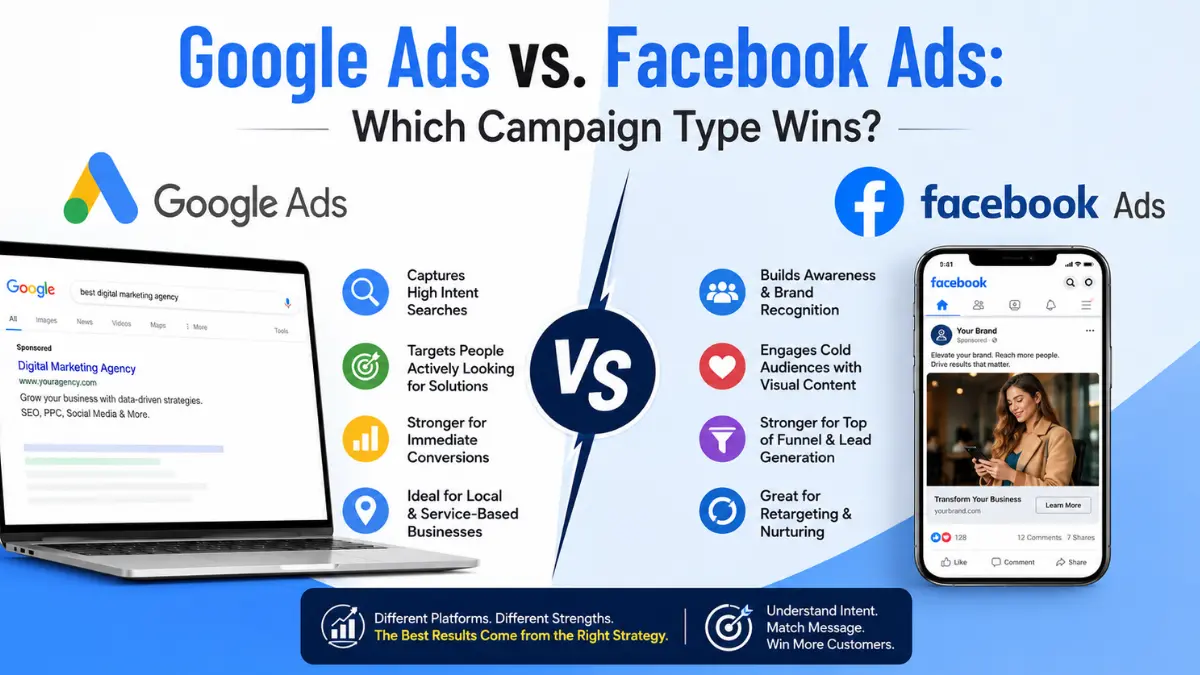

Google Ads vs Facebook Ads is not a question that should be answered by platform popularity. It should be answered by customer intent, buying stage, offer type, and the way a business expects people to make a decision.
Both platforms can produce leads, sales, traffic, and brand visibility. Both can also waste budget when used for the wrong purpose. The real difference is not that one platform is good and the other is weak. The real difference is that Google Ads is usually stronger when people are already looking for a solution, while Facebook Ads is usually stronger when a business needs to create interest before the customer starts searching.
The clear answer is this: Google Ads usually wins for high-intent demand capture, while Facebook Ads usually wins for demand creation, visual persuasion, and audience warming.
That means the winning platform depends on the campaign’s job.
Main Difference Between Google Ads and Facebook Ads
Google Ads is built around search behavior, commercial intent, and active problem-solving. A person goes to Google because they want an answer, a product, a service, a comparison, a nearby provider, or a solution to a specific problem.
Facebook Ads, through Meta’s advertising system, works differently. People are usually not opening Facebook or Instagram to search for a plumber, lawyer, business loan, accounting service, skincare brand, online course, or software tool. They are scrolling, watching, browsing, reacting, and discovering.
This difference matters because ad strategy must match the user’s mindset. A Google user may already know what they need. A Facebook user often needs to be interrupted with relevance, educated with clarity, and persuaded with proof before taking action.
The platform decision should begin with the customer’s buying behaviour, because advertising works best when the message appears at the same stage where the customer is ready to receive it.
Also Read: 7 Steps to Set Up a Google AdWords Campaign
Google Ads Wins When the Customer Already Has Intent
Google Ads is often the stronger choice when the customer already knows what they want or what problem they need solved.
This is especially true for businesses where people search before buying. Local services, legal services, medical clinics, insurance providers, home repair companies, software companies, consultants, and B2B service providers often benefit from Google because their customers use search when they are close to taking action.
A person searching for “emergency plumber near me” is not casually browsing. That person has a problem, a location need, and a likely intention to contact someone soon. A business that appears in that moment is not trying to create demand from nothing. It is trying to capture demand that already exists.
This is why Google Ads can be powerful for businesses with clear commercial keywords. The search query itself gives the advertiser a strong signal about what the person wants.
However, this strength also creates competition. High-intent keywords often cost more because many businesses want the same buyer at the same decision point. Google Ads can generate strong leads, but only when the business has a clear landing page, a strong offer, proper tracking, and a real ability to turn clicks into customers.
Google Ads is not valuable simply because it brings traffic; it is valuable when search intent, landing page relevance, and business economics work together.
Facebook Ads Wins When the Customer Needs to Be Persuaded First
Facebook Ads is usually stronger when the product or service needs visual explanation, emotional connection, repeated exposure, or demand creation.
This is common with beauty products, fitness offers, fashion, food, coaching, courses, home decor, personal brands, local events, lifestyle services, and products people may not search for until they first see them.
On Facebook and Instagram, the ad has to do more work. It must catch attention without feeling random. It must explain the value quickly without sounding shallow. It must show why the product or service matters before the person has actively asked for it.
This is why creative quality is central to Facebook Ads. Strong visuals, product demonstrations, customer proof, founder-led messaging, before-and-after examples, and clear offers can perform well because they help create interest during passive browsing.
Facebook Ads can also help a business stay visible over time. Many people do not buy after the first impression. They notice the brand, see it again, read comments, watch a video, visit the website, leave, and later return through retargeting or search.
Facebook Ads performs best when the business understands that attention is not the same as intent, and that cold audiences often need proof, repetition, and context before they become qualified buyers.
Also Read: 6 Reasons Google Is Intentionally Hiding Your Small Business
Which Platform Is Better for Immediate Leads?
Google Ads usually has the advantage for immediate leads when people are already searching for the service.
This is especially true for urgent or practical needs. A person searching for a dentist, roofer, attorney, HVAC repair company, accountant, or pest control service is already closer to action than someone casually seeing an ad in a social feed.
For lead generation, Google often brings fewer but more intentional users. The lead may cost more, but the lead may also have stronger buying intent.
Facebook can generate leads too, sometimes at a lower cost. However, Facebook leads often require stronger follow-up. Some users submit forms because the ad was interesting, not because they are ready to buy immediately. That does not make Facebook leads bad, but it means the business must judge them by qualified appointments, booked calls, closed sales, and revenue, not just cost per lead.
A cheaper lead is not automatically a better lead. A business should compare platforms by the cost of acquiring a real customer, not by the cost of collecting a form submission.
The most reliable comparison is not cost per click or cost per lead, but the cost of producing a qualified customer who can generate profit.
Which Platform Is Better for Brand Awareness?
Facebook Ads usually has an advantage for brand awareness because it allows businesses to reach people before they are actively searching.
A brand can introduce itself through images, videos, stories, testimonials, educational content, and repeated impressions. This is useful when the audience needs to understand the business before they trust it.
Google can also support awareness through YouTube, Display, and broader campaign types, but Google Search is strongest when the user already has a need. Facebook and Instagram are naturally stronger for discovery because users are already consuming visual and social content.
For new businesses, Facebook Ads can help create familiarity. People may not click immediately, but repeated exposure can make the brand feel more recognizable when they later search, compare, or receive a recommendation.
Brand awareness should not be treated as random reach. It should be connected to a clear audience, message, offer, and next step. Awareness without a business goal becomes expensive visibility.
Brand awareness has business value only when it increases future trust, search behaviour, direct visits, remarketing opportunities, or eventual conversions.
Which Platform Is Better for Ecommerce?
For ecommerce, the answer depends on whether the product already has search demand.
Google Ads is often strong when people are actively searching for the product, comparing options, checking prices, or looking for a specific category. Products with clear search demand can perform well because the user already has buying interest.
Facebook Ads is often stronger when the product is visual, emotional, new, lifestyle-based, or impulse-friendly. A product that looks interesting in a video or image can create desire before the customer ever searches for it.
For many ecommerce brands, the strongest strategy is not choosing only one platform. Facebook can introduce the product and build demand. Google can capture people later when they search for the brand, product type, reviews, alternatives, or buying options.
This is why ecommerce performance should be measured across the full buying path. A customer may first discover a product on Instagram, then search it on Google, then return through retargeting, and finally purchase after seeing proof or an offer.
Ecommerce advertising works best when discovery, comparison, retargeting, and purchase intent are treated as connected stages rather than separate platform results.
Which Platform Is Better for Local Businesses?
For many local businesses, Google Ads is usually the better first test when customers actively search for the service.
This applies to service businesses such as plumbers, electricians, roofers, dentists, lawyers, pest control companies, repair services, moving companies, and accountants. These businesses often depend on local intent, and Google is where many customers go when they need a provider.
Facebook Ads can still help local businesses, but its role is often different. It can promote seasonal offers, show reviews, introduce staff, display completed work, build local recognition, and retarget people who visited the website.
A local business with a limited budget should usually avoid spreading money across too many platforms too early. It should first identify where the strongest buying signal exists. If people already search for the service, Google may deserve priority. If the service depends on trust, visuals, community awareness, or repeat exposure, Facebook can become a strong support channel.
Local advertising should prioritize the platform that matches the customer’s moment of need, because local buyers often choose quickly when the problem is urgent or practical.
Also Read: 4 Signs Your Website Is Trapped in the “Google Sandbox”
Which Platform Is Better for B2B Businesses?
Google Ads often performs well for B2B businesses when buyers search with clear commercial intent.
A business owner searching for payroll software, commercial insurance, accounting help, CRM tools, legal services, cybersecurity support, or marketing agencies is already expressing a business need. In those cases, Google can place the offer near a serious decision.
Facebook Ads can still work in B2B, but it usually needs a more developed funnel. It may perform better for educational content, webinars, case studies, founder-led authority, retargeting, and long-cycle trust building.
B2B buyers often need more time, more proof, and more internal confidence before taking action. That means Facebook can support the relationship-building stage, while Google can capture stronger buying intent when the search happens.
In B2B advertising, the platform should be selected according to the seriousness of the buying signal, because business buyers rarely convert from casual attention without sufficient trust and relevance.
Budget Comparison: Where Should a Small Business Start?
A small business should not choose a platform only because one seems cheaper. Cheap clicks and cheap leads can still be expensive if they do not become customers.
Google Ads may cost more per click, but the user may be closer to buying. Facebook Ads may offer cheaper reach and leads, but the user may need more nurturing.
The best starting point depends on the offer.
A business with urgent, searchable services should usually test Google first. A business with visual products, lifestyle appeal, or a new offer people do not yet search for may test Facebook first.
The mistake many small businesses make is trying to run Google, Facebook, Instagram, YouTube, retargeting, lead forms, and awareness campaigns at the same time with a small budget. That creates scattered data and weak learning.
A better approach is to start with one clear campaign goal, one platform, one offer, one landing page, and one conversion action. Once the business understands what works, it can expand with more confidence.
Small-budget advertising requires focus because limited spend must produce useful learning, not scattered impressions across too many disconnected campaigns.
Campaign Type Comparison
| Campaign Goal | Better First Choice | Strategic Reason |
|---|---|---|
| Immediate calls from searchers | Google Ads | The customer is already looking for a solution |
| Local emergency services | Google Ads | Urgency and search intent are high |
| New product discovery | Facebook Ads | The audience may need to see the product first |
| Visual product promotion | Facebook Ads | Images and videos can create desire |
| High-ticket professional leads | Google Ads first, Facebook for retargeting | Search captures intent, social builds trust |
| Brand awareness | Facebook Ads | Social platforms support repeated exposure |
| Ecommerce with existing demand | Google Ads | Buyers may already search and compare |
| Ecommerce with impulse appeal | Facebook Ads | Creative can generate interest quickly |
| B2B search demand | Google Ads | Query intent can show serious business need |
| Long-cycle trust building | Facebook Ads | Repeated educational exposure can support the funnel |
This comparison shows that the winning platform depends on the campaign’s job. A platform should not be judged in isolation. It should be judged by whether it is being used for the right stage of the buying journey.
When Google Ads Is the Better Choice
Google Ads is the better choice when the customer is already searching, comparing, or ready to contact a provider.
It is also better when the business can identify commercial keywords with strong buying meaning. Searches that include location, service type, pricing, quote, near me, best, company, provider, or emergency often show stronger intent.
Google Ads also works well when the business has a strong landing page and can handle inquiries properly. A high-intent click is valuable only if the business can turn that click into a call, form submission, booking, or sale.
Google is not the right platform for every offer. If people do not know the product exists, search demand may be too weak. In that case, the business may need to create awareness before search campaigns can scale.
Google Ads should be used when there is enough existing demand to capture and when the business has the conversion system required to profit from that demand.
When Facebook Ads Is the Better Choice
Facebook Ads is the better choice when the business needs to introduce, explain, demonstrate, or emotionally position an offer.
It is especially useful when the product can be shown visually. A strong product video, customer transformation, demonstration, review, or lifestyle image can help people understand value before they search for it.
Facebook Ads is also useful for retargeting. Many users visit a website and leave without buying. Meta campaigns can bring those people back with reminders, proof, offers, or new angles.
However, Facebook Ads should not be treated as a shortcut. It requires creative testing, audience understanding, message clarity, and a follow-up system. Without these elements, the platform may generate attention without producing revenue.
Facebook Ads should be used when the business has a message strong enough to turn passive attention into active interest.
The Best Strategy Is Often Google and Facebook Together
For many businesses, the strongest long-term strategy is not choosing Google or Facebook forever. It is using both platforms for different jobs.
Facebook can create demand. Google can capture demand. Facebook can retarget visitors. Google can protect branded search. Facebook can educate cold audiences. Google can serve people who are closer to action.
This matters because customers do not always follow a straight path. Someone may first see a business on Instagram, search it later on Google, visit the website, leave, see another ad, read reviews, and then finally submit a form.
If a business judges only the final click, it may misunderstand the full role of each platform. The better strategy is to understand how each platform contributes to awareness, trust, search behavior, and conversion.
A mature advertising strategy assigns each platform a clear role instead of forcing one platform to perform every stage of the customer journey.
Which Campaign Type Wins?
Google Ads wins when the business needs to reach people who are already searching for a product, service, or solution.
Facebook Ads wins when the business needs to create interest, build familiarity, show visual proof, and warm up an audience before they are ready to buy.
For high-intent services, Google Ads is usually the stronger starting point. For visual, lifestyle, educational, or discovery-based offers, Facebook Ads can be the stronger starting point. For businesses with enough budget and tracking discipline, using both together can create a more complete system.
The best campaign type is the one that matches the customer’s intent, the offer’s complexity, and the business’s sales process.
A business should not ask, “Which platform is better?” It should ask, “Where is my customer in the decision process, and which platform reaches them at that exact stage with the right message?”
