
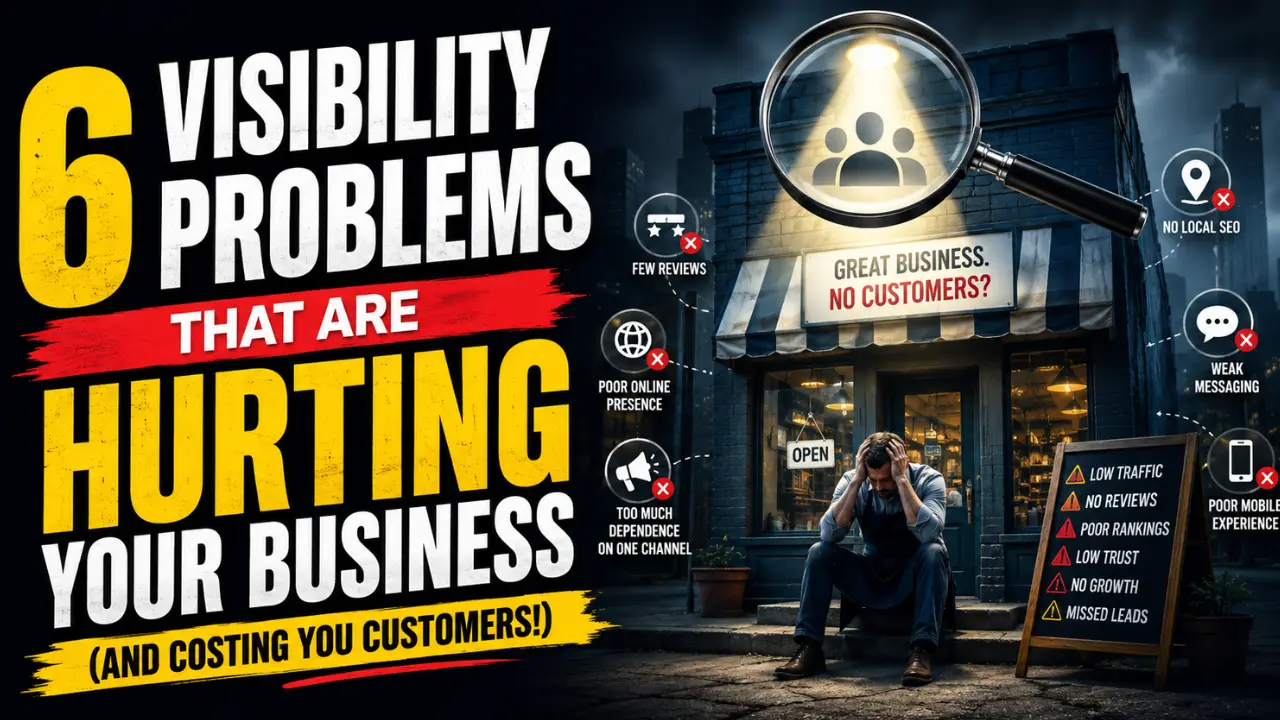

It feels like a conspiracy. You have spent months building a beautiful website, pouring money into your services, and perfecting your products. Yet, your traffic dashboard looks like a ghost town. It is enough to make you wonder: why is my website not showing up on Google?
The truth is closer to “yes” than you might think. While the algorithm isn’t personal, Google is intentionally hiding your business from search results. A small business website getting no traffic is rarely an accident. It happens because your site is sending the wrong technical signals to indexing bots, trapping you in a digital blind spot. If you are suddenly losing Google search impressions, you are likely triggering the algorithm’s filters without realizing it.
The good news is that you are not permanently banned. You just need to know how to fix website visibility on Google by eliminating basic mistakes. Let’s look at the 6 exact reasons Google is hiding your small business right now—and the simple, actionable fixes to force your way back onto page one.
1. Missing Valuable Search Traffic
The most damaging visibility problem is not simply low traffic. It is missing the moments when customers are already ready to choose.
Many small businesses chase broad attention through social media posts, general promotions or random advertising, but they remain weak during high-intent searches. This creates a serious gap because not all visibility has the same commercial value.
A person casually scrolling social media may notice a business and forget it seconds later. But someone searching “emergency plumber near me,” “best accountant for small business taxes,” “same day AC repair,” “family lawyer consultation,” or “roof leak repair service” is already in problem-solving mode. That person has a need, urgency and a reason to compare options.
If the business does not appear during those searches, it is absent from one of the most valuable parts of the customer journey.
Commercial Value Comes From Intent
General awareness can help a brand become familiar but high-intent visibility captures customers when demand already exists. This is especially important for local services, professional services, repair companies, clinics, restaurants, contractors and appointment-based businesses.
A small business can receive many impressions and still generate few customers if those impressions come from people with weak intent. A smaller number of high-intent visitors may produce more calls, bookings and sales than thousands of passive views.
This is why visibility quality matters more than visibility volume. The business does not only need to be seen. It needs to be seen at the right stage of customer decision-making.
Weak Local SEO Reduces Visibility
Many small businesses are not fully visible in local search because their digital foundation is incomplete. A Google Business Profile may exist but that does not mean it is strong enough to compete.
Search platforms need enough signals to understand what the business does, where it operates, how active it is and whether customers trust it. Common weaknesses include incomplete categories, missing services, outdated hours, weak descriptions, poor-quality photos, inconsistent contact information, few reviews, unanswered reviews and no location-specific website content.
These details may appear small individually, but together they influence whether a business looks relevant and trustworthy enough to appear prominently.
For example, two contractors may serve the same city but the one with updated project photos, recent reviews, detailed service descriptions, location relevance and consistent business information will often look stronger than the one with an outdated profile and a thin website. Businesses that strengthen [local search visibility signals that help small businesses appear more trustworthy online — Why Optimized Local Profiles Consistently Outperform Weak Business Listings] often improve both rankings and customer confidence at the same time.
Reviews Can Increase Visibility
Many businesses focus only on total review count but review momentum also matters. A company with many old reviews may appear less active than a competitor receiving steady recent reviews.
Fresh reviews tell customers that people are still using the business and that recent experiences are positive. They also create activity signals that can support local relevance. Customers often read recent reviews first because they want to know what the business is like now, not several years ago.
This is why review generation should not be treated as a one-time reputation task. It is an ongoing visibility asset. A business that steadily earns honest customer feedback keeps sending the market a signal that it is active, trusted and still relevant.
Local Content Improves Visibility
Another common problem is relying only on a homepage and one or two generic service pages. Local search often depends on geographic relevance and service specificity. A business that serves multiple areas may need clear location-specific content to match local searches properly.
A roofing company serving several towns, for example, should not only say “we provide roofing services.” It should explain its services, service areas, common local roofing problems, storm-related issues, repair processes, materials, timelines, inspection steps and customer expectations. This gives search engines more context and gives customers more confidence.
A business with one thin page has limited search surface area. A business with strong service pages, local pages, helpful guides and detailed FAQs has more opportunities to appear for different customer searches.
Visibility grows when the business gives both search engines and customers more useful reasons to recognize it.
2. Generic Business Messaging Fails
A business can be visible and still fail if people do not understand what makes it worth choosing.
This happens when small businesses use language that sounds professional but does not communicate anything specific. Phrases such as “quality service,” “trusted professionals,” “customer satisfaction,” and “innovative solutions” appear everywhere. These statements may be true but they do not create distinction.
Customers cannot easily remember a business that sounds like every other business in the market.
Weak Messaging Creates Blur
Customers are exposed to too many options. When several companies use the same broad promises, the customer’s mind does not create a clear reason to remember one over another. The business may be seen but not truly recognized.
A vague message also forces customers to work harder. They must figure out who the business serves, what problem it solves, what result it provides and why it is different. Most people will not do that work for long, especially when competitors explain themselves more clearly.
A weak message says, “We provide digital marketing solutions.”
A stronger message says, “We help local restaurants increase reservation calls through Google Ads and local SEO.”
The second message is more memorable because it identifies the audience, the problem, the channel and the outcome. It gives the customer something concrete to understand and repeat.
Clear Positioning Builds Clarity
Many businesses lose customers not because the offer is bad but because the customer feels uncertain. Uncertainty slows action. If visitors cannot quickly understand whether the service fits their need, they leave or keep comparing.
A strong business message should quickly answer four questions: what the business does, who it helps, what problem it solves and why someone should trust it.
This matters on the homepage, Google Business Profile, social media bios, advertisements, landing pages and service pages. Customers should not need to scroll deeply or decode vague language just to understand the company.
Specificity Makes Referrals Easier
Vague businesses are harder to recommend. If someone cannot clearly explain what a company does, they are less likely to refer it.
A business described as “a marketing agency” is forgettable. A business described as “the agency that helps local dental clinics get more booked appointments through Google Ads” is much easier to remember and recommend.
Strong visibility is not only about reaching strangers. It also helps existing customers, partners and contacts describe the business accurately to others.
Poor Messaging Reduces Uniqueness
When positioning is vague, customers often compare mainly by price. This is dangerous because the business loses the chance to explain why its expertise, process, speed, reliability, specialization or service quality deserves a stronger choice.
Clear positioning protects a business from becoming interchangeable. It gives customers a reason to choose based on fit and trust, not only cost.
3. Expertise Needs Online Visibility
Many small businesses are far more capable than their online presence suggests. This creates a dangerous gap between real-world quality and digital perception.
A business may have years of experience, skilled staff, loyal customers and strong service standards, yet its website may look thin, outdated, vague or inactive. When this happens, potential customers judge the business before they ever experience its actual quality.
Modern customers often decide whether a business feels trustworthy before making contact. They scan the website, reviews, photos, service pages, FAQs, social activity and overall presentation. If these signals feel weak, customers may assume the business itself is weak.
Expertise Must Be Visible to Build Trust
Many owners believe their work should speak for itself, but online customers cannot see that work unless the business makes it visible. Expertise must be demonstrated, not merely claimed.
A business that says “we are experienced” is making a claim. A business that explains common customer mistakes, pricing factors, timelines, safety concerns, process steps, comparison points and realistic expectations is demonstrating expertise.
That difference matters because customers use visible expertise as a trust shortcut. They feel safer when a business helps them understand the decision they are about to make.
Thin Content Hurts Visibility and Trust
Many small business websites contain service pages that are too short to be useful. A page may simply name the service, add a few generic benefits and end with a contact button. This does not give search engines much context and it does not give customers enough confidence.
A stronger service page explains what the service includes, who needs it, common problems, warning signs, process steps, expected timelines, pricing factors, preparation requirements, common mistakes and what makes the company’s approach reliable.
This kind of depth improves visibility because it answers real customer questions. It also improves conversion because the business feels more competent and transparent.
Helpful Content Builds Authority
Educational content is not just for blogging. It is a visibility system.
A business that publishes useful answers around its services creates more entry points from search. For example, a roofing company with content about roof leaks, storm damage, insurance claims, roof lifespan, repair versus replacement, material comparisons, seasonal maintenance and warning signs has far more visibility opportunities than a company with only a homepage.
The same applies to accountants, lawyers, consultants, dentists, electricians, restaurants, ecommerce stores and software providers. Each customer question can become a search entry point, a trust builder and a conversion assistant.
This also creates topical authority. A business that covers a service area deeply appears more credible than one that publishes random disconnected content. Search engines and customers both respond better when the business demonstrates depth around a clear area of expertise.
Real Proof Builds More Trust
Businesses often rely too much on promotional language and too little on proof. Customers want evidence that the company can actually deliver.
Strong trust signals include project photos, case studies, before-and-after examples, team information, certifications, detailed reviews, customer stories, transparent policies, guarantees, service explanations and real business photos.
Stock images can make a website look polished but too many generic visuals can also make it feel less authentic. For many local businesses, real photos of staff, work, location, tools, projects and customers can create stronger trust than perfect but generic imagery.
Visibility improves when customers feel they are dealing with a real, active, competent business.
4. Inconsistent Signals Hurt Trust
Small businesses often underestimate how much consistency affects visibility. Customers and search platforms both rely on repeated signals to understand and trust a business. When those signals are inconsistent, confidence drops.
This problem is especially common when a business has been operating for several years. Old listings, outdated social profiles, changed phone numbers, old addresses, inconsistent logos, forgotten directories and abandoned pages can remain visible online long after the business has moved on.
To customers, this creates confusion. To search engines, it can reduce confidence in the accuracy and legitimacy of the business information.
Trust Requires Verification
Modern customers rarely judge a business from one source. They may open the website, scan the Google profile, read reviews, check Facebook, look at Instagram, compare directory listings and search the business name.
If the website says the store closes at 8 PM, Google says 6 PM and Facebook shows an old holiday schedule from two years ago, the customer may not call to confirm. They may simply choose another business that feels more reliable.
The same happens when an old address appears in one directory, a different phone number appears on another listing or an abandoned social page makes the company look inactive. These small conflicts create hesitation at the exact moment the customer should feel confident.
Entity Trust Supports Local SEO
Local search visibility depends partly on confidence. Search systems compare business names, addresses, phone numbers, categories, websites and other references across the web. When this information is inconsistent, the platform may have less confidence in the business entity.
This does not mean one old listing will destroy visibility but widespread inconsistency can weaken local authority and create unnecessary friction.
A small business should regularly audit its name, address, phone number, website, hours, categories and service descriptions across major platforms.
Inactive Profiles Reduce Credibility
Many businesses create social media pages, directory profiles or promotional pages and then stop updating them. Over time, these abandoned assets become trust liabilities.
A Facebook page with the last post from 2021, unanswered messages, old holiday promotions or outdated hours can make the business look inactive. Unanswered negative reviews can make the company look careless. Broken website links can make it look poorly maintained.
Customers do not always separate marketing neglect from operational neglect. If the online presence feels ignored, some people assume the business may ignore customers too.
Familiarity Builds Trust
A consistent digital identity helps customers recognize the business across multiple touchpoints. The same name, tone, logo, colours, service descriptions, photos and promises create familiarity. Familiarity reduces uncertainty and reduced uncertainty increases trust.
This matters because visibility is relative. A business is not judged in isolation; it is compared against competitors. If one competitor appears consistent, active and polished across platforms while another appears fragmented, the consistent business feels safer even before direct contact.
The more consistently a business presents itself, the easier it becomes for customers to remember it, compare it and choose it with confidence. This is why businesses that build [a consistent brand presence across websites, reviews, and social platforms — How Digital Consistency Increases Customer Trust and Local Visibility] often create stronger long-term recognition in competitive local markets.
5. Bad Mobile UX Loses Customers
Mobile experience is one of the most overlooked visibility problems because businesses often focus on whether people can find the website, not what happens after they arrive.
A business may rank well, appear in ads or receive referral traffic, but if the mobile experience is slow, confusing or frustrating, visibility turns into lost opportunity.
This is especially damaging because many local and urgent searches happen on mobile devices. Customers looking for a restaurant, repair service, clinic, appointment, store or emergency help often want fast answers and easy action.
Mobile Visitors Act Faster
Mobile users usually scan before they read deeply. They want immediate clarity: what the business offers, where it operates, whether it is open, how to contact it and whether it looks trustworthy.
If the page loads slowly, the menu is confusing, buttons are too small, contact information is hidden or popups interrupt the experience, many users leave before the business ever has a chance to persuade them.
This makes mobile usability a revenue issue, not just a design issue.
Small Delays Feel Bigger on Mobile
Many users do not consciously think, “This business is unreliable.” Instead, friction creates impatience. Slow loading, unstable layouts, tiny buttons, intrusive popups and confusing forms create emotional resistance. The customer simply feels that choosing this business is harder than choosing another one.
That feeling is enough to lose the lead.
For urgent searches, the effect is even stronger. Someone searching for emergency help is unlikely to wait patiently for a slow page or fight with a complicated form. They will return to search results and choose the next business that feels easier.
Make Contact Easy to Find
Many small business websites hide the most important action steps. A customer should not struggle to find the phone number, booking button, directions, service area, pricing guidance or consultation process.
A strong mobile experience makes action simple. Click-to-call buttons, clear service pages, visible hours, simple forms, location information and fast navigation all reduce friction.
The goal is not only to look professional. The goal is to help motivated customers take the next step with as little confusion as possible.
Mobile UX Influences SEO
Mobile usability can also affect organic visibility because search engines care about page experience, speed, accessibility and user satisfaction. If users quickly abandon a site because it performs poorly, that behaviour can weaken performance over time.
Poor mobile experience therefore damages the business twice. It reduces conversions from visitors who already arrived and it may also limit future visibility by weakening engagement and usability signals.
6. Visibility Needs Diversification
One of the most dangerous visibility problems is depending too heavily on a single source of attention. Many small businesses grow through one channel and then become vulnerable because they never build a broader visibility system.
This channel may be Facebook, Instagram, Google Ads, referrals, walk-in traffic, an online marketplace, one large client or one local partnership. The channel may work well for a while but overdependence creates risk.
Traffic Loss Is Often Slow First
Businesses often imagine platform risk as a dramatic event, such as an account suspension, a major algorithm update or a sudden traffic collapse. Those things can happen but visibility loss often arrives more quietly.
A paid advertising channel may keep producing leads but each lead becomes more expensive as competition increases. A social media page may still receive engagement but fewer followers see each post. A marketplace listing may still generate sales but ranking pressure, fees and discount competition slowly reduce profit. A referral pipeline may continue but the volume becomes less predictable as customer networks change.
This kind of slow visibility decay is dangerous because the business may not notice the problem until margins are already weaker.
Digital Platforms Change Quickly
Digital platforms are not stable assets controlled by the business. Algorithms change, ad costs rise, organic reach declines, competitors enter the market, marketplace rules shift and accounts can be restricted.
For example, a company built mostly on paid ads may struggle when cost per click rises. A business relying on Instagram reach may suffer when organic distribution drops. A store depending on marketplace rankings may lose sales after a policy or ranking change. A referral-based business may slow down when customer networks become less active.
The business may still be good but its visibility pipeline becomes fragile.
Multiple Channels Create Stability
A stronger visibility system uses multiple channels that support one another. Local SEO, organic search, reviews, email marketing, referrals, partnerships, content, social media, video, paid ads and customer retention can work together.
This does not mean every small business must use every channel. It means the business should not depend entirely on one source it does not control.
For example, a local service business may combine Google Business Profile optimization, review generation, service pages, local content, referral relationships, call tracking and follow-up emails. An ecommerce brand may combine search content, product pages, email retention, creator partnerships, paid ads and customer reviews.
Visibility becomes more stable when no single platform carries the entire business.
Businesses Need Owned Audiences
Owned audiences are especially valuable because they reduce dependence on algorithms. Email lists, SMS subscribers, loyalty programs, customer communities, memberships and repeat-customer systems allow a business to communicate directly with people who already know it.
This matters because acquiring attention is becoming more expensive. Businesses that keep direct relationships with customers usually have more resilience when ad costs rise or platform reach declines.
Owned visibility also improves lifetime value. Repeat customers, referrals and reactivation campaigns often cost less than constantly finding new customers from scratch.
Visibility Builds Gradually
Strong visibility is rarely built from one viral post, one ad campaign or one lucky ranking. It usually compounds through repeated trust signals, helpful content, consistent branding, customer satisfaction, reviews, local relevance and clear positioning.
Businesses that build visibility as an asset tend to become more resilient. Businesses that treat visibility as occasional promotion often remain dependent on short bursts of attention.
Why Visibility Issues Hurt Businesses
Visibility problems are difficult because they rarely appear as one obvious failure. Instead, they create what can be called a visibility leak. Customers may enter the decision journey but they quietly drop out at different points because something weakens discovery, trust, clarity or action.
One customer never finds the business in search. Another finds it but does not understand the offer. Another visits the website but loses confidence because the page looks thin. Another checks reviews and sees no recent activity. Another tries to call but cannot easily find the number on mobile. Another sees conflicting business hours and chooses a competitor instead.
None of these moments may look dramatic on their own. Together, they create a silent loss of opportunity.
The business may blame competition, pricing, the economy or customer behaviour, while the deeper issue is that visibility is failing across multiple points of the customer journey.
Modern visibility depends on three connected outcomes: being found, being trusted and being chosen. If any one of these fails, growth becomes harder.

2 thoughts on “6 Reasons Google Is Intentionally Hiding Your Small Business”