
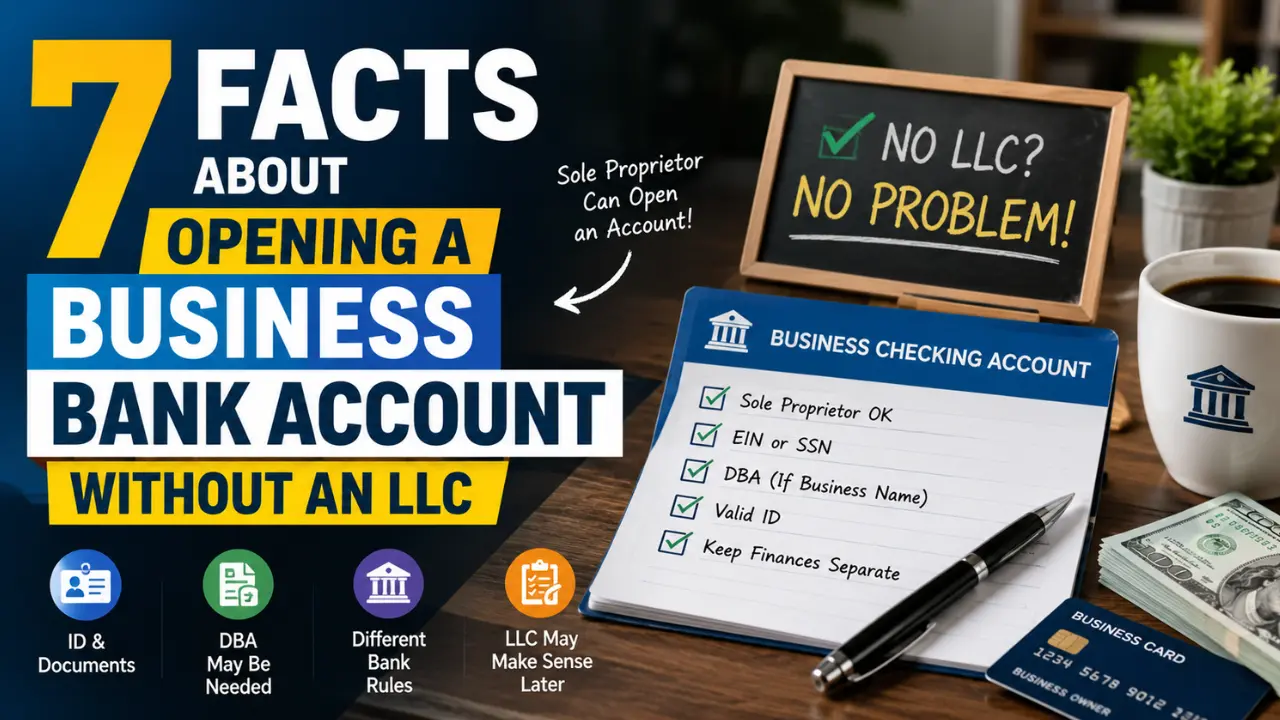

Yes, many business owners can open a business bank account without an LLC, especially if they operate as a sole proprietor. The exact requirements depend on the bank, the business name, the state, and whether the owner is using a personal name or a separate business name.
For many new business owners, the confusion starts because “business bank account” sounds like something only an LLC, corporation, or registered company can open. In reality, many sole proprietors also open separate business accounts to keep business money away from personal spending. The important point is that the bank still needs to verify who owns the business, what name the business uses, and what tax identification information applies.
A sole proprietor is generally someone who owns an unincorporated business by themselves, according to the IRS. The SBA also notes that business bank account requirements can include an EIN or Social Security number for a sole proprietorship, plus other documents depending on the business structure.
This guide explains what new business owners should understand before trying to open a business bank account without forming an LLC first.
Can You Open a Business Bank Account Without an LLC?
Yes, you can often open a business bank account without an LLC if you are operating as a sole proprietor, but the bank may ask for personal identification, your Social Security number or EIN, your business name and address, and DBA paperwork if you are using a name different from your legal name.
This does not mean every bank will ask for the same documents. Some banks may allow a simple sole proprietor business checking account with basic information. Other banks may require additional proof of business name registration, licensing, ownership, or tax identification.
The key difference is this:
A business bank account does not always require an LLC, but it does require the bank to understand who owns the business and how the business is legally identified.
That is why a person running a small business under their own name may have fewer document requirements than someone using a brand name, trade name, or “doing business as” name.
Many small businesses lose money on Google Ads because they start with a random daily budget instead of a clear testing plan. Before running your first campaign, read 6 Ways to Plan Your First Google Ads Budget Without Waste so you can connect your budget to goals, click costs, customer value, and tracking.
1. A Sole Proprietor May Not Need an LLC to Open an Account
A sole proprietor is one of the simplest ways to operate a business because the business is not formed as a separate legal entity like an LLC or corporation. The owner and the business are closely connected, which is why the bank may treat the account differently from an LLC account.
For example, if someone named David Miller provides freelance design services under his own legal name, the bank may view that as a sole proprietorship. In that case, the bank may ask for David’s identification, tax information, business details, and possibly proof of business activity, depending on the institution.
This is different from opening an account for “Miller Creative Studio LLC,” because an LLC usually has formation documents, an EIN, and official state records connected to the entity.
A sole proprietor does not automatically have the same legal separation as an LLC. The SBA explains that sole proprietorships do not create a separate business entity, meaning business assets and liabilities are not separate from personal ones.
That is why opening a business bank account can help with organization, but it should not be confused with forming an LLC. A bank account can separate money for bookkeeping, but it does not create the same legal structure as an LLC.
2. The Bank Will Usually Ask for Personal Identification
Even if you do not have an LLC, the bank still needs to know who is opening the account. This is why personal identification is usually part of the process.
Banks commonly ask for information such as a government-issued ID, legal name, address, date of birth, contact information, and ownership details. Bank of America lists personal identification, business name and address, EIN or Social Security number for sole proprietors, and formation documents depending on structure as common business account requirements.
This step is not only about the business. It is also about verifying the person responsible for the account.
For a sole proprietor, the owner is usually the main person connected to the account. If there are additional authorized signers or applicants, the bank may ask for their information as well.
This is why a new business owner should not walk into a bank expecting the account to be opened only with a business idea or a website name. The bank needs identity details first.
3. You May Need an EIN or Social Security Number
A sole proprietor may be able to use a Social Security number for a business bank account, but some owners choose to get an EIN. An EIN is an Employer Identification Number, which is a federal tax identification number for a business.
The IRS provides an official way to apply for an EIN online, and the IRS states that the tool lets users get an EIN directly from the IRS for free.
An EIN can be useful because it gives the business a separate tax identification number to use in many business situations. It may also make the business look more organized when applying for business accounts, licenses, vendor accounts, or future credit relationships.
However, an EIN does not automatically create an LLC. That is an important distinction.
A person can have an EIN as a sole proprietor and still not have an LLC. Forming an LLC is a separate state-level business formation process. Getting an EIN is a federal tax identification step.
For many beginners, the clean way to understand it is this:
- SSN: May be used by some sole proprietors, depending on the bank and situation.
- EIN: Often useful for business banking, hiring, taxes, licenses, and business identity.
- LLC: A legal business structure formed through state filing.
A bank may accept different tax identification details depending on the account type and business structure, so the safest step is to check the bank’s document list before applying.
4. A DBA May Be Needed If You Use a Business Name
This is one of the most important points for anyone opening a business bank account without an LLC.
If you use your personal legal name, the process may be simpler. But if you use a business name that is different from your legal name, the bank may ask for DBA proof.
DBA means “doing business as.” It can also be called an assumed name, trade name, or fictitious business name, depending on the state or local rules. Bank of America explains that a DBA is used when a person or corporation does business under a name different from its legal name.
For example, if Maria Lopez runs a cleaning service under the name “Bright Home Cleaning,” the bank may want proof that Maria is allowed to use that business name. Without DBA proof, the bank may not want to open the account under “Bright Home Cleaning” because the business name is not clearly connected to the owner.
Chase also notes that an assumed name certificate may be required when a business operates with a DBA, depending on the location and business situation.
This is where many new business owners get delayed. They think they can simply choose a business name and open an account under that name. But the bank may need documentation showing that the name is registered or properly connected to the owner.
Many small businesses fail with paid ads because they start with a random daily budget instead of a realistic test plan, so it helps to first learn how to plan your first Google Ads budget before increasing ad spend.
5. Banks May Have Different Rules
One of the biggest mistakes beginners make is assuming every bank follows the same process. Business account requirements can differ by bank, state, business type, ownership structure, and account type.
One bank may allow a sole proprietor to apply online with basic details. Another may ask the owner to visit a branch. One bank may ask for DBA paperwork in certain states. Another may have different document requirements for sole proprietors, partnerships, LLCs, and corporations.
This is why the answer to “Can I open a business bank account without an LLC?” is usually yes, but with conditions.
A better question is:
What does this specific bank require for a sole proprietor business checking account?
Before applying, check the bank’s official requirements for your business type. Look especially for details about:
- Personal ID
- SSN or EIN
- Business name
- Business address
- DBA or assumed name certificate
- Business license, if applicable
- Ownership information
- Formation documents, if the business is an LLC or corporation
This saves time because you can prepare the right documents before starting the application.
6. A Business Account Helps Separate Business and Personal Money
Even if you do not have an LLC, a separate business bank account can still be useful. The main value is organization.
When business income and personal spending are mixed in one personal account, it becomes harder to understand profit, expenses, taxes, cash flow, and growth. A separate account makes the business easier to track.
Bank of America notes that opening a business bank account can help separate personal and business finances, making recordkeeping and cash flow tracking easier.
A separate business account can help with:
- Cleaner bookkeeping: Business income and expenses are easier to review.
- Tax preparation: Records are easier to organize when business transactions are separate.
- Professional payments: Customers may feel more comfortable paying a business name.
- Cash flow tracking: The owner can see how much money the business actually has.
- Expense control: Business spending becomes easier to monitor.
- Future financing preparation: Lenders may want to review business banking history.
This is practical even for very small businesses. A freelance writer, local cleaner, consultant, mobile mechanic, online seller, photographer, tutor, or home service provider can benefit from separating business money from personal money.
However, the owner should understand the limit. A business bank account helps organize money, but it does not automatically create legal liability protection. If the owner wants legal separation, they should learn whether an LLC or another business structure makes sense for their situation.
7. An LLC May Still Be Useful Later
You do not always need an LLC to open a business bank account, but an LLC may still become useful later depending on the business.
An LLC can help create a more formal business structure. It may also support liability separation, business credibility, ownership planning, and future growth. However, forming an LLC also comes with state filing requirements, possible annual fees, tax considerations, and compliance responsibilities.
This is why beginners should not form an LLC only because they think it is the only way to open a business bank account. That may not be true. At the same time, they should not ignore LLC formation if their business has risk, partners, employees, contracts, physical services, liability exposure, or plans to grow.
A useful way to think about it is this:
- A business bank account helps organize money.
- An LLC helps structure the business legally.
- They are connected, but they are not the same thing.
If the business is still testing an idea, a sole proprietor account may be enough to start. If the business is earning steady income, signing contracts, hiring help, taking on liability, or building a serious brand, it may be time to compare sole proprietorship and LLC options carefully.
For legal and tax decisions, business owners should speak with a qualified professional in their state instead of relying only on general online information.
What Documents Might You Need to Open a Business Bank Account?
The documents can vary, but this table gives a practical beginner-level overview.
| Business Situation | Possible Documents the Bank May Ask For |
|---|---|
| Sole proprietor using personal legal name | Personal ID, SSN or EIN, business address, contact information |
| Sole proprietor using a business name | Personal ID, SSN or EIN, DBA or assumed name certificate, business address |
| LLC | Personal ID, EIN, Articles of Organization or formation documents, operating agreement if required |
| Partnership | Personal ID for owners, EIN, partnership agreement, business registration documents if required |
| Corporation | Personal ID, EIN, Articles of Incorporation, corporate resolutions or ownership documents if required |
This table should be treated as a planning guide, not a universal checklist. Always check the exact bank requirements before applying.
Should You Open a Business Bank Account Before Forming an LLC?
You can open a business bank account before forming an LLC if you are operating as a sole proprietor and the bank accepts your documents. This may be useful if you are already earning business income, paying business expenses, or trying to organize your finances before the business becomes larger.
However, if you plan to form an LLC very soon, you may want to think carefully before opening the account. If you open a sole proprietor account now and then form an LLC later, the bank may require a new account or updated documentation for the LLC. The LLC is a different business structure, so the bank may need the LLC’s formation documents and EIN.
This does not mean you should delay banking forever. It means you should match the account to your current business stage.
A sole proprietor account may make sense when:
- You are starting small.
- You are testing the business idea.
- You are earning under your own name.
- You want cleaner bookkeeping before forming an LLC.
- You do not yet need a formal entity structure.
Waiting for the LLC account may make sense when:
- You plan to form the LLC soon.
- You want the account under the LLC name.
- You need legal structure before signing contracts.
- You will have partners, employees, or higher business risk.
- You want your banking records connected to the LLC from the beginning.
The right choice depends on timing, risk, documents and the seriousness of the business plan.
Common Mistakes to Avoid
Many new business owners make the process harder than it needs to be. The most common mistake is trying to open an account under a business name without having DBA paperwork or proper name documentation.
Another mistake is assuming an EIN means the business is now an LLC. It does not. An EIN is a tax identification number, while an LLC is a legal entity formed through the state.
Some owners also open a business account but continue mixing personal and business spending. That weakens one of the main reasons for opening the account in the first place.
Avoid these mistakes:
- Using a business name without DBA proof: The bank may need documentation for that name.
- Confusing EIN with LLC formation: An EIN does not create an LLC.
- Mixing personal and business transactions: This makes bookkeeping harder.
- Choosing an account without checking fees: Monthly fees, transaction limits, and minimum balances matter.
- Ignoring state or local requirements: DBA, license, and registration rules can vary.
- Waiting too long to separate money: Business records become harder to clean up later.
A business bank account should make your business easier to manage, not more confusing.
Can You Open a Business Bank Account Without an LLC?
Yes, you can often open a business bank account without an LLC if you operate as a sole proprietor. The bank may ask for personal identification, your Social Security number or EIN, your business address, and DBA paperwork if you use a business name different from your legal name.
An LLC is not always required for business banking, but it may still be useful later if your business needs a more formal structure, liability separation, ownership planning, or stronger professional credibility.
The safest approach is to decide how your business is currently operating, check the bank’s requirements for sole proprietors, prepare your identification and tax information, and register a DBA if you want the account under a business name.
A business bank account is not only about opening an account. It is about building cleaner financial habits from the beginning. Even before forming an LLC, separating business money from personal money can make your bookkeeping, taxes, payments, and cash flow much easier to manage.

1 thought on “7 Business Banking Rules to Know Before Forming an LLC”