
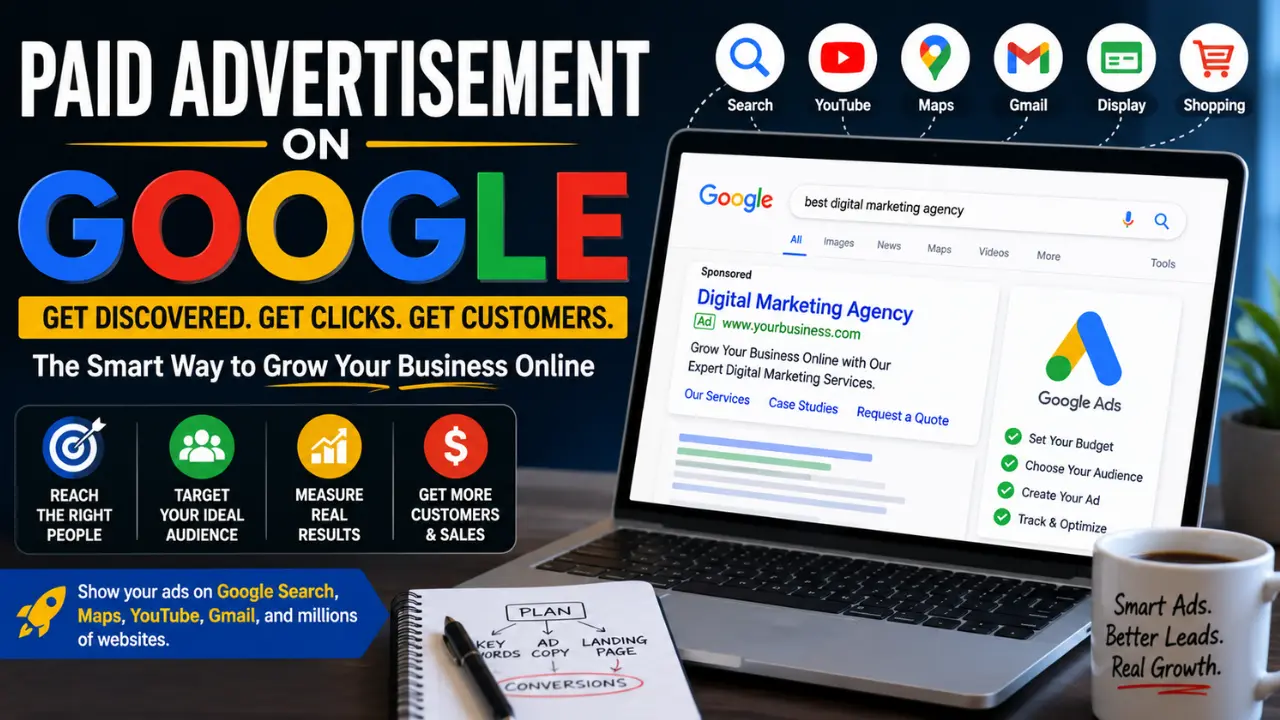

Paid advertisement on Google means using Google Ads to promote a business through paid placements. You choose a goal, set a budget, target the right audience or keywords, create an ad, and pay when people interact with that ad depending on the campaign type and bidding method.
For small businesses, the real value of Google advertising is not simply “getting traffic.” The value is reaching people at the moment they already have buying intent. Someone searching for “emergency plumber near me,” “best HVAC repair company,” or “family lawyer in Dallas” is not casually browsing. That person may already be close to making a decision, which is why Google Ads can become powerful when the campaign is built with clear targeting, strong landing pages, and proper conversion tracking.
What Is Paid Advertisement on Google?
Paid advertisement on Google is online advertising where a business pays to display ads across Google’s advertising network. These ads can appear above or below organic search results, inside Google Maps, on YouTube, across websites in the Display Network, in Gmail, on Shopping results, and through automated campaign types like Performance Max.
The most common form is Google Search Ads. These are text ads that appear when someone types a search query into Google. For example, if a local roofing company wants more leads, it may run ads for searches like “roof repair near me,” “roof leak repair,” or “best roofing contractor in my area.”
The business does not simply pay to appear anywhere. It creates a campaign around a specific goal, such as phone calls, form submissions, store visits, online purchases, appointment bookings, or website traffic. Google then uses the campaign settings, keywords, audience signals, budget, bids, ad quality, and competition level to decide when and where the ads may appear.
Many small businesses lose money on Google Ads because they start with a random daily budget instead of a clear testing plan. Before running your first campaign, read 6 Ways to Plan Your First Google Ads Budget Without Waste so you can connect your budget to goals, click costs, customer value, and tracking.
Why Businesses Use Google Ads
Businesses use Google Ads because it can place them in front of people who already have commercial intent. This is different from general social media promotion, where people may see an ad while scrolling but may not be actively searching for that service.
Google Ads can be useful when a business wants to:
- Generate leads from phone calls, forms, bookings, or quote requests.
- Increase sales for products, services, or online stores.
- Promote local services to people in a specific city or service area.
- Bring traffic quickly to a new website or landing page.
- Test demand before investing heavily in long-term SEO.
- Retarget visitors who already visited the website but did not convert.
The strongest use case is when the business already knows what kind of customer it wants. A vague campaign usually wastes money. A focused campaign can reveal which keywords, locations, offers, and landing pages produce real business results.
How Google Paid Ads Are Different From Organic Search
Google paid ads and organic search results can both appear on the same search results page, but they work differently.
Paid ads are shown through Google Ads. A business pays to compete for ad placement based on campaign settings, bidding, ad quality, relevance, and auction conditions. Organic results are unpaid listings that Google ranks based on its search systems.
This difference matters because paid ads can bring visibility faster, but the traffic stops when the budget stops. Organic SEO usually takes longer, but strong rankings can bring traffic without paying for every click.
A small business should not treat paid ads and SEO as enemies. They work best together. Google Ads can bring immediate leads while SEO builds long-term trust, authority, and lower-cost traffic over time.
Where Paid Ads Can Appear on Google
Paid advertisement on Google is not limited to the search results page. Depending on the campaign type, business goal, and settings, ads can appear across several Google surfaces.
Google Search
Search ads appear when someone searches for a keyword related to your business. These are often best for high-intent leads because the user is actively looking for something.
A law firm, dentist, plumber, roofing company, tax advisor, personal trainer, or local service provider can benefit from Search Ads when the keywords are chosen carefully.
Google Maps
Ads can appear in local search results and map placements. This is useful for local businesses that depend on nearby customers, such as restaurants, clinics, salons, repair services, gyms, and contractors.
For local businesses, Google Maps visibility can be extremely valuable because users are often searching with location-based intent. They may want directions, a phone number, reviews, opening hours, or a quick booking option.
YouTube
YouTube ads help businesses reach people through video. These ads can support brand awareness, product education, retargeting, and demand creation.
YouTube may not always produce immediate leads like Search Ads, but it can help when the product or service needs explanation. For example, a home remodeling company, software brand, coaching business, or medical clinic may use video ads to build trust before asking for a conversion.
Google Display Network
Display ads appear on websites, apps, and placements within Google’s ad network. These are usually image-based or responsive ads.
Display campaigns are often better for awareness and retargeting than direct high-intent search leads. They can remind previous website visitors about your offer, show promotions, or keep your brand visible after someone has already shown interest.
Shopping Ads
Shopping ads are useful for ecommerce businesses. They show product images, prices, store names, and product details directly in search or shopping placements.
These ads work best when the product feed is accurate, pricing is competitive, images are clear, and the website has a smooth checkout experience.
Performance Max
Performance Max is a campaign type that can show ads across Google’s available advertising inventory from one campaign. It uses Google’s automation and machine learning to find potential customers based on the campaign goal, assets, audience signals, product feed if applicable, and conversion data.
Performance Max can be useful, but it should not be treated as a magic button. It still needs strong inputs: clear conversion tracking, quality images, good copy, proper audience signals, and a landing page that can convert visitors into leads or customers.
How the Google Ads Auction Works
Google Ads does not work like a simple system where the highest bidder always wins. When someone searches or visits a place where ads can appear, Google runs an ad auction to decide which ads are eligible, which ads show, and in what order.
The auction looks at several factors, including bid amount, ad relevance, landing page quality, expected performance, competition, user context, and ad assets. This means a business with a lower bid can sometimes perform better than a competitor if its ad and landing page are more relevant.
This is important for small businesses because budget alone is not the only weapon. A smaller advertiser can compete more effectively by building tightly focused campaigns, writing clear ads, using relevant keywords, improving landing pages, and tracking real conversions.
How Much Does Paid Advertisement on Google Cost?
The cost of Google Ads depends on your industry, location, competition, keywords, campaign type, and conversion goal. Some keywords cost very little per click, while competitive industries such as legal services, insurance, home repair, finance, and B2B services can become expensive.
The important question is not only “How much does a click cost?” The better question is “How much does it cost to get a real lead or sale?”
For example, a $2 click can still be expensive if none of the visitors become customers. A $40 click can be profitable if it brings a qualified lead worth hundreds or thousands of dollars.
A business should measure cost in stages:
- Cost per click: How much you pay for each ad click.
- Cost per lead: How much you spend to get one form submission, call, booking, or quote request.
- Cost per customer: How much you spend to acquire one paying customer.
- Return on ad spend: How much revenue comes back compared with ad spend.
- Lifetime value: How much a customer may be worth over time, not just on the first purchase.
A campaign is not successful because it gets cheap clicks. It is successful when it brings the right people at a cost the business can afford.
What You Need Before Running Google Ads
Many businesses start Google Ads too early. They create a campaign, add a few keywords, send traffic to the homepage, and then wonder why the budget disappears without results.
Before running paid advertisement on Google, a business should prepare the basics.
A Clear Offer
The ad should promote something specific. A vague message like “We provide quality services” does not give the user a strong reason to click.
A better offer is direct and useful: free estimate, same-day repair, no-obligation consultation, emergency service, first appointment discount, local specialist, online quote, or fast booking.
The offer must match what the customer wants at that moment. Someone searching for urgent repair does not want to read a long brand story first. They want proof, price clarity, location relevance, and a fast way to contact the business.
A Proper Landing Page
Sending paid traffic to a weak homepage can waste money. A landing page should match the search intent behind the ad.
A strong Google Ads landing page usually includes:
- A clear headline matching the service or offer.
- A short explanation of the problem and solution.
- Trust signals such as reviews, certifications, experience, or guarantees.
- A visible phone number or form.
- Location or service-area details.
- Fast loading speed, especially on mobile.
- A clear call to action.
The landing page should not make visitors work hard to understand what to do next. Paid traffic is expensive, so the page must remove friction.
Conversion Tracking
Conversion tracking tells you what happens after someone clicks the ad. Without tracking, you may know how many clicks you received, but you will not know which clicks became calls, leads, purchases, or bookings.
For a small business, this is one of the most important parts of Google Ads. Without tracking, decisions are based on guesswork. With tracking, you can see which keywords, ads, locations, and devices are bringing real business outcomes.
A Realistic Budget
Google Ads needs enough budget to collect data. A tiny budget in a competitive market may not produce enough clicks to understand what is working.
That does not mean every business needs a large budget from day one. It means the starting budget should match the cost level of the industry. A local service business in a high-cost city may need a stronger test budget than a small niche ecommerce store with low-cost products.
A good starting mindset is to treat the first month as controlled learning, not instant profit. The goal is to identify what converts, remove waste, and improve the campaign step by step.
Best Campaign Type for Small Businesses
The best campaign type depends on what the business sells and what kind of customer it wants.
For most local service businesses, Search Ads are often the strongest starting point because the user is already searching with intent. A plumber, electrician, dentist, lawyer, roofing company, or cleaning business usually needs leads from people who are actively looking for help.
For ecommerce businesses, Shopping campaigns or Performance Max with a product feed may be more useful because users can see product details before clicking.
For brands that need education, YouTube and Display can support awareness and retargeting. These may not always be the first choice for direct lead generation, but they can help build trust when used with a clear strategy.
For businesses with enough conversion data, Performance Max can help expand reach across Google’s channels. However, it should be monitored carefully because automation works best when the campaign has accurate conversion signals and strong creative assets.
Common Mistakes Businesses Make With Google Ads
Google Ads can work well, but it can also waste money quickly when the setup is weak. Many failed campaigns fail because of basic mistakes, not because Google Ads itself is bad.
Targeting Too Broadly
A small business should not target every possible keyword, location, and audience. Broad targeting can bring irrelevant clicks from people who are not ready to buy or are outside the service area.
The campaign should begin with the most valuable intent. For example, “emergency AC repair near me” is usually more valuable than a broad keyword like “air conditioner.”
Sending Traffic to the Wrong Page
If the ad promotes roof repair but the landing page talks about every construction service, the user may leave. The page should continue the exact promise of the ad.
A paid visitor should feel, “This page is exactly what I searched for.”
Ignoring Negative Keywords
Negative keywords stop ads from showing for irrelevant searches. For example, a paid plumbing company may not want clicks from people searching for “free plumbing course,” “plumbing jobs,” or “DIY plumbing tools.”
Without negative keywords, the campaign can spend money on people who were never going to become customers.
Judging Too Early
Some business owners stop after a few days because they do not see instant results. Others keep spending for months without checking performance. Both approaches are risky.
A campaign needs enough data to evaluate, but it also needs active management. The right approach is to review search terms, conversions, cost per lead, landing page behavior, and keyword quality regularly.
Tracking the Wrong Goal
Website visits are not always the best goal. A local business needs calls, forms, appointments, directions, or quote requests. An ecommerce business needs purchases, cart actions, and revenue.
If the campaign optimizes for weak goals, Google may bring more of the wrong actions. The campaign should be built around business results, not vanity metrics.
Is Paid Advertisement on Google Worth It?
Paid advertisement on Google is worth it when the business has a clear offer, a defined customer, a proper landing page, and the ability to track conversions. It is not worth it when the business only wants random traffic without a plan to turn visitors into customers.
Google Ads is especially useful when people already search for your product or service. If there is clear demand, paid ads can capture that demand quickly. If people do not yet know they need your product, then Search Ads may be limited, and YouTube, Display, or other awareness campaigns may be needed first.
The best way to judge Google Ads is not by clicks alone. A serious business should ask:
- Are the clicks relevant?
- Are visitors contacting us?
- Are the leads qualified?
- What is the cost per lead?
- What percentage of leads become customers?
- How much revenue does one customer bring?
- Can we scale the campaign without losing profitability?
When these numbers are clear, Google Ads becomes easier to manage. It stops being a guessing game and becomes a measurable growth channel.
Simple Google Ads Plan for a Small Business
A small business does not need to start with every campaign type at once. A simpler approach is usually safer.
Start with one clear service or product category. Choose the offer that has strong demand and good profit potential. Build a landing page for that offer. Set up conversion tracking before spending seriously. Then create a focused Search campaign around high-intent keywords.
For example, a local HVAC company should not start with a broad campaign for every HVAC-related term. It may begin with “AC repair,” “emergency AC repair,” or “furnace repair” in a specific service area. Once the campaign proves that leads are coming at a profitable cost, the business can expand into more services or campaign types.
The goal is not to spend everywhere. The goal is to find the first profitable pocket of demand and improve it.
Paid Ads and SEO Should Work Together
Google Ads can bring traffic quickly, but it should not replace SEO. Organic search builds long-term visibility and trust. Paid ads help test keywords, offers, landing pages, and customer intent faster.
A business can use Google Ads data to improve SEO decisions. If certain keywords convert well in paid campaigns, those topics may deserve stronger landing pages, service pages, blog content, or local SEO work.
At the same time, SEO can reduce total dependency on ads. When a business earns organic rankings, it may not need to pay for every visitor forever. The strongest strategy often combines paid visibility for immediate demand with organic visibility for long-term authority.
Practical Meaning of Google Paid Advertising
Paid advertisement on Google works best when it is treated as a business system, not just a traffic source. The ad, keyword, landing page, offer, location, budget, and tracking all need to support the same goal.
A business that only wants visibility may spend money without understanding results. A business that tracks real leads and sales can learn which searches are profitable and which ones should be removed.
For small businesses, the smartest approach is to begin narrow, measure carefully, improve the landing page, remove wasted clicks, and scale only after the campaign proves that it can bring customers at a sustainable cost.

2 thoughts on “Paid Advertisement on Google: How It Works for Small Businesses”