
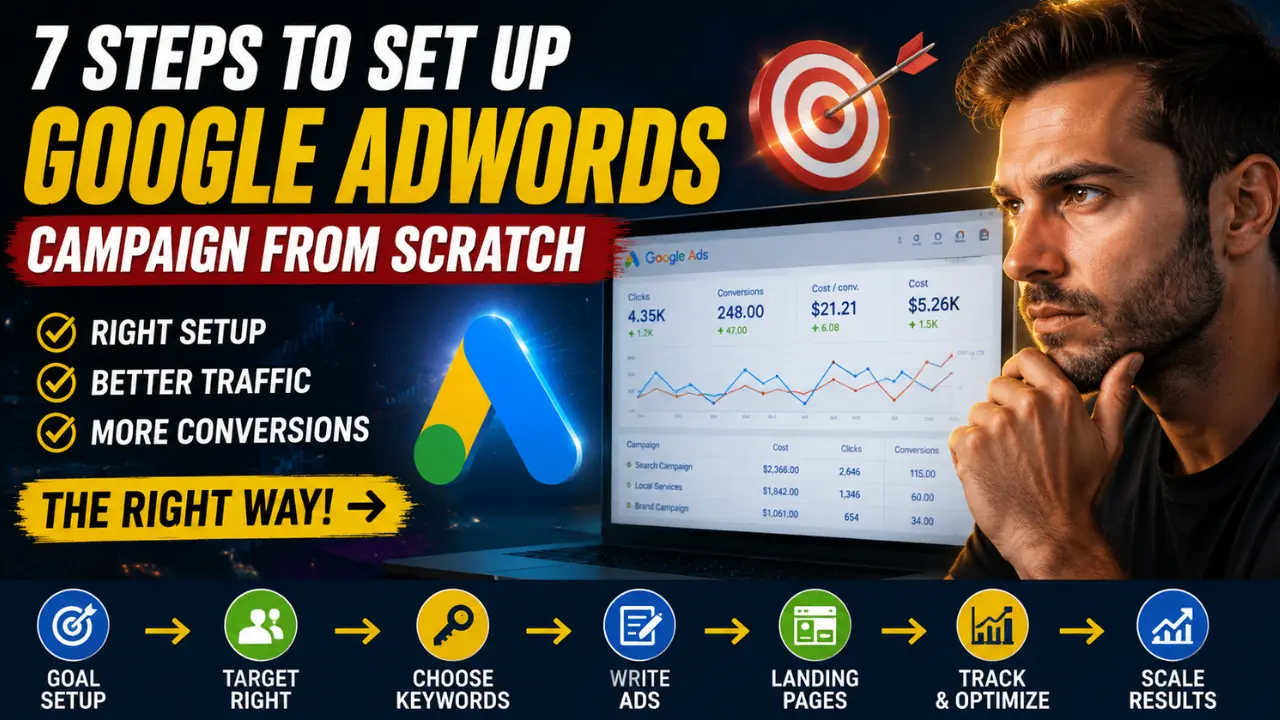

Google AdWords is now officially called Google Ads, although many business owners still use the older name because it remains familiar. The platform has changed significantly over time but the core objective has stayed largely the same: helping businesses appear in front of people already searching for a product, service or solution.
Many first-time advertisers assume Google Ads is mainly about visibility. They open the platform, enter a few keywords, write short ads, set a budget and launch quickly. The campaign may begin generating impressions and clicks within a short time but activity alone does not indicate that the setup is healthy. A campaign can spend consistently while producing weak leads, poor conversion quality, irrelevant traffic or little meaningful business value.
In many cases, this happens because the campaign structure was built before the business goals, targeting logic, landing pages and tracking systems were properly prepared.
A well-structured Google Ads campaign functions more like a connected business system than a simple advertising tool. The campaign goal influences keyword selection. Keywords influence ad structure. Ad structure influences landing page relevance. Landing page quality affects conversion behaviour. Conversion data then influences future bidding and optimization decisions, especially when businesses understand [how conversion tracking and campaign structure improve long-term ad performance — Why Google Ads Campaign Structure and Tracking Matter for Optimization].
When those layers support each other properly, campaigns generally become easier to optimize, easier to scale responsibly and more capable of producing stable long-term results.
Why Setup Quality Matters
Google Ads works best when the platform can clearly understand:
- what the business offers
- which searches matter most
- which users are likely to convert
- what action should count as success
If those signals are inconsistent, the campaign may still generate traffic but the optimization process becomes less reliable because the account is collecting mixed data from mixed search intent.
For example, if someone searches for “emergency AC repair near me,” the keyword, ad, landing page, contact method and service area should all support that same need. If the user instead lands on a broad homepage discussing unrelated services, the experience becomes less relevant immediately, which can reduce conversion quality.
This is one reason smaller but cleaner campaigns often perform more reliably than larger campaigns built around broad targeting and unclear structure.
Quick Setup Overview
| Setup Layer | Main Purpose | Why It Matters |
|---|---|---|
| Goal | Defines success | Prevents low-value traffic focus |
| Campaign type | Controls where ads appear | Aligns ads with search intent |
| Location and language | Filters audience | Reduces irrelevant clicks |
| Budget and bidding | Controls learning pace | Protects early testing spend |
| Keywords and ad groups | Organizes search themes | Improves relevance |
| Ads and assets | Supports search continuity | Improves click quality |
| Landing page | Supports conversion behavior | Reduces wasted visits |
| Tracking and launch review | Measures outcomes | Enables optimization |
Weak setup decisions early in the process often create optimization problems later.
Step 1: Define the Goal First
The first step is not selecting keywords. The first step is deciding what the campaign should accomplish for the business.
Many advertisers initially describe their goals as:
- more visibility
- more traffic
- more clicks
However, those are activity metrics rather than business outcomes.
Google Ads generally performs better when campaigns are connected to a measurable commercial objective. A plumbing company may prioritize emergency phone calls. A clinic may prioritize appointment bookings. An ecommerce store may prioritize purchases. A consultant may prioritize qualified inquiries. A software company may prioritize demo requests.
Each objective changes the campaign setup because different goals require different:
- keyword strategies
- landing pages
- conversion tracking methods
- bidding approaches
- customer journeys
Goals Determine Direction
If the campaign is designed to generate phone calls, the setup may place more emphasis on:
- mobile traffic
- local intent searches
- visible click-to-call options
- fast-loading landing pages
- immediate trust signals
If the campaign is designed for ecommerce purchases, greater emphasis may be placed on:
- product relevance
- checkout flow
- pricing visibility
- revenue tracking
- product-focused search intent
If the campaign supports B2B lead generation, the landing page may require:
- stronger credibility indicators
- business-oriented messaging
- case studies or proof
- lower-friction lead forms
- longer decision support
This is why campaign setup should begin with business context rather than platform settings alone. Before launching ads, the business should understand what a valuable lead actually looks like, how quickly the team can respond and whether the campaign is intended to generate urgent inquiries, scheduled appointments or online sales, which is why [defining clear conversion goals before launch improves campaign efficiency and lead quality — How to Set Effective Google Ads Conversion Goals for Your Business].
Step 2: Configure the Campaign Properly
Many new advertisers move through campaign settings quickly because they want the ads running immediately. This can create avoidable inefficiencies before the campaign has gathered enough useful data.
For businesses starting from scratch, a Search campaign is often one of the clearest starting points because it targets users already searching for something specific.
Searches such as:
- emergency plumber near me
- AC repair in Dallas
- tax accountant for small business
- dentist open Saturday
often indicate direct intent. The user is already looking for help, service or information connected to an existing need.
Other campaign types such as Display, YouTube, Demand Gen and Performance Max may become valuable later but they usually require:
- stronger creative assets
- cleaner conversion tracking
- better audience understanding
- more historical campaign data
Why Search Ads Work Well Early
Search campaigns make early optimization easier because advertisers can review:
- which search terms triggered the ads
- which keywords attracted clicks
- which searches produced conversions
- where spend may be inefficient
That visibility makes it easier to understand traffic quality during the first learning stage.
Another useful safeguard during early setup is avoiding unnecessary network expansion before Search performance is understood clearly. A cleaner Search-focused setup often makes traffic analysis and optimization decisions easier to interpret.
Location Settings Affect Reach
Location targeting should reflect the real service area.
A local clinic serving one city usually should not target an entire country. A contractor operating in one region generally should not advertise across multiple states unless the business truly serves those areas.
Another common issue is using broad location behaviour settings that allow ads to appear for users merely “interested in” a location. Many local campaigns perform more consistently when targeting focuses primarily on users physically located within the service area.
Language settings should also match the landing page experience. Sending users to pages they cannot understand often reduces conversion quality.
Learn Before Scaling Spend
The first campaign budget should support controlled testing rather than aggressive expansion.
A budget that is too small may not collect enough meaningful data. A budget that is too large can increase wasted spend if targeting, landing pages or tracking systems are still weak.
The same principle applies to bidding.
For brand-new campaigns with limited conversion history, aggressive Target CPA bidding too early can sometimes restrict delivery because the platform does not yet understand which clicks are most valuable.
Early optimization is usually more useful when the campaign is collecting information about:
- search quality
- keyword relevance
- lead behavior
- landing page performance
- conversion patterns
Once the account has enough reliable conversion data, bidding decisions often become easier to evaluate.
Step 3: Build for Real Searches
One common beginner mistake is grouping unrelated services into one broad campaign.
Someone searching:
“emergency AC repair”
is usually in a different decision stage than someone searching:
“new AC installation cost.”
If both searches trigger the same ad and land on the same page, the experience becomes less relevant.
Google Ads generally performs more consistently when keywords, ads and landing pages support the same search intent.
Intent Separation Improves Campaign
Each ad group should represent one clear search theme.
For example, an HVAC company may separate:
- emergency AC repair
- furnace repair
- AC installation
- maintenance service
A dental clinic may separate:
- emergency dentist
- teeth cleaning
- dental implants
- braces
A local accountant may separate:
- bookkeeping
- payroll
- tax filing
- business registration
This structure usually improves:
- ad relevance
- landing page continuity
- click quality
- reporting clarity
- optimization decisions
It also helps businesses understand which services are generating useful leads or revenue.
Weak vs Strong Campaign Structure
| Weak Structure | Stronger Structure |
|---|---|
| One ad group for all services | Separate ad groups by intent |
| Generic ads | Service-specific ads |
| Homepage for all traffic | Relevant landing pages |
| Mixed search themes | Clear search segmentation |
Example Campaign Setup
For a local HVAC business, a beginner-friendly structure may look like this:
| Setup Item | Example |
|---|---|
| Campaign type | Search campaign |
| Location | Real service city or radius |
| Main goal | Calls and repair requests |
| Ad group 1 | Emergency AC repair |
| Ad group 2 | AC installation |
| Ad group 3 | Furnace repair |
| Keywords | Service + near me, service + city |
| Landing pages | Matching service pages |
| Conversions | Calls, forms, bookings |
The structure is relatively simple, but each section has a clear purpose.
Step 4: Choose Keywords Carefully
Keyword selection determines who enters the campaign.
Many beginners choose keywords primarily because search volume appears attractive. However, higher traffic volume does not automatically produce stronger business results.
A person searching:
“how to fix AC yourself”
is often behaving differently from someone searching:
“24 hour AC repair near me.”
One may be researching information. The other may need immediate service.
Intent Is More Valuable Than Volume
Strong buyer-intent keywords often include:
- service terms
- urgency terms
- location terms
- pricing terms
- appointment terms
- problem-solving language
Examples include:
- emergency electrician near me
- roof repair estimate
- water heater repair nearby
- dentist open Saturday
- small business tax accountant
These searches often indicate stronger commercial intent because the user is already closer to taking action.
Weak vs Strong Keyword Direction
| Weak Intent Keyword | Stronger Buyer Intent Keyword |
|---|---|
| plumbing tips | emergency plumber near me |
| roof ideas | roof repair estimate |
| accounting advice | small business tax accountant |
| gym exercises | personal trainer near me |
| skincare information | acne treatment clinic |
This does not mean informational keywords are always bad. The issue is allowing low-intent searches to dominate early campaigns before the advertiser understands which traffic actually converts.
Negative Keywords Filter Bad Traffic
Negative keywords help block searches that do not align with the campaign goal.
| Business Type | Possible Negative Keywords |
|---|---|
| Local repair service | jobs, salary, DIY, manual, free |
| Consultant | course, certification, template |
| Clinic | free treatment, home remedy |
| Ecommerce store | used, repair, wholesale if irrelevant |
| Contractor | training, jobs, supplies |
These are starting points rather than universal rules.
For example, a repair business may block “DIY,” but someone searching “cheap washing machine repair near me” could still represent legitimate customer intent. Negative keyword strategy generally improves over time through search term analysis and campaign learning.
Step 5: Build Ads Around User Intent
A useful Google Ads campaign does more than attract clicks. It helps users move from the search to the next business action with less confusion.
Many weak ads remain too generic.
Phrases such as:
- trusted experts
- quality service
- affordable solutions
may sound acceptable but they often fail to answer the user’s immediate concerns clearly.
Someone searching:
“24 hour locksmith near me”
is usually evaluating questions such as:
- can this business respond quickly?
- do they serve my area?
- does the business appear trustworthy?
- is contacting them straightforward?
An ad saying:
“Professional Security Solutions”
may not address those concerns clearly enough.
Weak vs Strong Ad Direction
| Search Intent | Weak Ad | Stronger Ad |
|---|---|---|
| emergency electrician | Quality Electrical Services | 24/7 Emergency Electrician Near You |
| roof leak repair | Trusted Roofing Experts | Roof Leak Repair and Same-Day Inspection |
| small business tax help | Professional Accounting Solutions | Small Business Tax Accountant |
| AC not cooling | Affordable HVAC Service | AC Not Cooling? Book Local Repair |
The stronger version is usually more specific and more aligned with the original search intent.
Ad Assets Improve Decision Clarity
Ad assets can help users evaluate the business more quickly.
Useful assets may include:
- call assets
- sitelinks
- location assets
- structured snippets
- callouts
For example:
- call assets support direct contact from mobile devices
- location assets reinforce local presence
- sitelinks can guide users to booking pages, pricing pages or emergency services
- callouts can highlight practical trust indicators such as licensed technicians or same-day appointments
Ad messaging should also remain realistic. Promising response times, pricing or guarantees that the business cannot consistently deliver may improve clicks temporarily but can weaken trust later in the customer journey.
Step 6: Align Ads and Landing Pages
Landing pages are where many campaigns begin losing efficiency.
The keyword may be relevant and the ad may match the search intent but if the landing page feels unclear, slow, confusing or disconnected from the original search, users often leave before converting.
A landing page should confirm the same promise made in the ad.
If the ad focuses on emergency AC repair, the page should quickly communicate:
- emergency AC repair service
- service area
- contact methods
- response expectations
- customer proof
- clear next steps
Homepage vs Dedicated Landing Page
| Homepage Traffic | Dedicated Landing Page |
|---|---|
| Broad messaging | Intent-specific messaging |
| Multiple distractions | One clear service focus |
| Generic calls-to-action | Relevant next step |
| Slower decision-making | Faster decision confidence |
A homepage introduces the overall business. A paid search landing page often performs better when it supports one specific intent clearly.
What Effective Pages Include
Strong landing pages often contain:
- clear headline
- service-specific explanation
- local relevance
- visible contact options
- testimonials or reviews
- mobile-friendly layout
- fast loading speed
- clear call-to-action
The exact structure may vary depending on whether the campaign supports local services, ecommerce or B2B lead generation.
Step 7: Track Before Scaling
A Google Ads campaign should not be launched seriously without conversion tracking.
Without tracking, advertisers cannot clearly evaluate:
- which keywords convert
- which ads generate leads
- which landing pages perform well
- which traffic sources matter
The campaign may appear active while producing little measurable business value.
What Should Be Tracked
Tracking depends on the business model.
Examples include:
- phone calls
- form submissions
- purchases
- bookings
- quote requests
- demo requests
Before increasing budget, businesses should manually test:
- forms
- phone calls
- thank-you pages
- conversion recording
- tracking accuracy
Broken tracking often creates unreliable optimization decisions.
Controlled Learning Works Better
New campaigns generally need stable learning conditions.
Many beginners:
- rewrite ads too quickly
- switch bidding repeatedly
- add large keyword lists suddenly
- pause campaigns too early
- judge performance after very little data
This often creates inconsistent optimization patterns.
New campaigns usually should not be evaluated from only a few clicks or a single day of activity. Early performance data is often incomplete and unstable. Optimization decisions generally become more reliable once the campaign has collected enough meaningful behaviour data.
During the early phase, advertisers often benefit from focusing on:
- search term quality
- click-through behavior
- CPC trends
- conversion patterns
- landing page performance
- wasted spend indicators
Pre-Launch Checklist
| Setup Area | What to Confirm |
|---|---|
| Goal | Main conversion is clearly defined |
| Campaign type | Matches search intent |
| Location | Targets real service area |
| Language | Matches landing page audience |
| Budget | Supports controlled testing |
| Bidding | Not overly restrictive |
| Keywords | Focused on buyer intent |
| Negative keywords | Obvious waste blocked |
| Ads | Match search intent |
| Assets | Useful and relevant |
| Landing page | Continues ad promise |
| Tracking | Fully tested before launch |
Common Ad Setup Errors
Many Google Ads campaigns struggle because of weak fundamentals rather than advanced technical issues.
| Mistake | Why It Hurts |
|---|---|
| Targeting too broadly | Wastes spend outside the real market |
| Launching without tracking | Makes performance difficult to evaluate |
| Using broad keywords too early | Attracts weaker traffic |
| Sending all traffic to homepage | Weakens relevance |
| Choosing strict bidding too soon | Restricts learning |
| Mixing unrelated services | Reduces campaign clarity |
| Judging campaigns too quickly | Creates unstable optimization |
A campaign should be structured clearly enough for both Google and the customer to understand. Google relies on clean signals about search intent, locations, ads, pages and conversions. Customers rely on a clear path between the original search and the final business action.
Why These 7 Steps Matter Together
A Google AdWords campaign from scratch generally performs better when it is treated as a connected business system rather than a quick traffic experiment.
The campaign goal influences the structure. The structure influences keyword organization. Keywords influence ad relevance. Ads influence landing page expectations. Landing pages influence conversion behavior. Conversion data then supports future optimization decisions.
When those layers align properly, campaigns generally become easier to manage, easier to evaluate and more stable over time.
Campaigns that perform consistently are often built on:
- clear search intent
- organized structure
- reliable tracking
- relevant landing pages
- measured optimization decisions
The long-term performance of a campaign is usually influenced more by setup quality and decision consistency than by how quickly budget is increased, especially when businesses understand [why sustainable Google Ads growth depends on optimization systems rather than budget increases alone — How to Scale Google Ads Campaigns Without Losing Profitability].
Frequently Asked Questions
How much budget should a beginner start with in Google Ads?
A beginner budget should usually support testing without creating excessive risk. The right amount depends on the industry, keyword competition and campaign goal. Instead of focusing only on daily spend, businesses should focus on collecting enough data to understand search quality, conversion behaviour and wasted traffic patterns.
Should beginners start with Search campaigns first?
For many businesses, Search campaigns are often easier to manage in the beginning because they target users already searching for a service or solution. Search campaigns also make keyword behaviour and conversion analysis easier to review during early optimization.
Why are negative keywords important in Google Ads?
Negative keywords help block searches that do not match the business goal. They reduce irrelevant clicks and help protect the budget from traffic that is unlikely to convert.
How long should a new Google Ads campaign run before making major changes?
New campaigns usually need enough time and data before major optimization decisions are made. Judging performance too early can create unstable bidding and inconsistent learning patterns.
What should businesses track before increasing budget?
Businesses should track the actions that matter most to revenue or lead quality. This may include calls, form submissions, bookings, purchases or qualified inquiries depending on the business type.

3 thoughts on “7 Steps to Set Up a Google AdWords Campaign”