
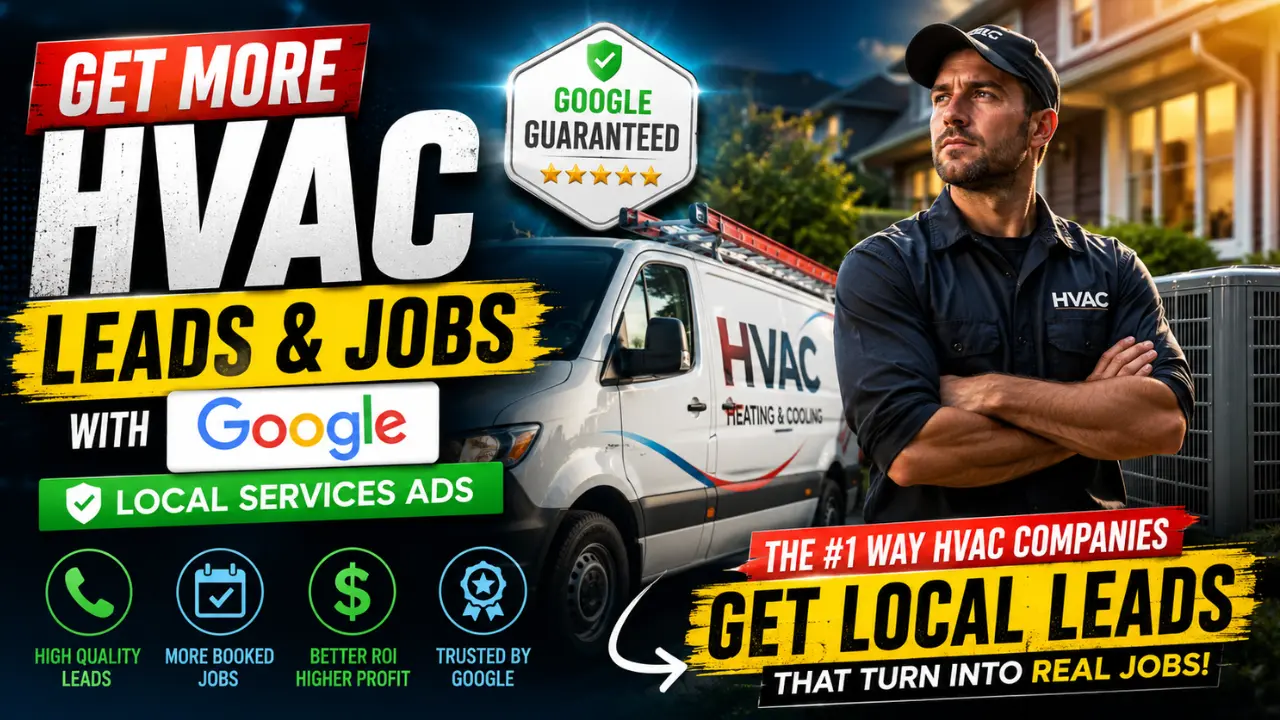

Google Local Services Ads can put an HVAC company in front of homeowners who are already looking for help. These searches often happen when an AC stops cooling, a furnace fails, a heat pump acts up or a family needs urgent heating and cooling service.
That makes Local Services Ads useful for HVAC lead generation but they do not become profitable by visibility alone. The campaign works best when the company can answer quickly, serve the right locations, choose the right job types and turn leads into booked service calls.
For HVAC companies, the real measure is not how many leads come in. The real measure is how many of those leads become profitable jobs in the areas the company actually wants to serve.
How Local Services Ads Work for HVAC Companies
Google Local Services Ads are built for local service businesses that want direct customer inquiries. Instead of focusing mainly on website clicks, the format is designed around calls, messages and booking requests from nearby customers.
For an HVAC company, the ad can show business details such as the company name, reviews, service area, hours, contact options and verification signals. This gives the customer a quick way to compare local HVAC providers before visiting a website.
That matters because many HVAC customers are not in a slow research stage. They may need a technician soon and they are often looking for a company that looks trustworthy enough to contact immediately.
Also Read: Is Your Business Invisible on Google? Here’s the Fix
LSAs Are Different From Regular Google Ads
Local Services Ads are not the same as normal Google Search Ads.
Regular Google Ads usually depend on keywords, ad copy, bidding, landing pages and click-based traffic. A customer clicks the ad, visits the page and then decides whether to call or submit a form.
Local Services Ads are more profile-driven. The customer sees the business profile, reviews, service type and contact options directly in the ad experience. The lead often comes before the customer deeply explores the website.
For HVAC contractors, both formats can be useful but they serve different roles. Standard Google Ads may work better for controlled landing pages, financing offers, installation campaigns and specific replacement promotions. Local Services Ads are usually stronger for direct service demand, especially when customers want fast help from a nearby provider.
Why LSAs Fit HVAC Search Behaviour
HVAC searches often come from discomfort, urgency or uncertainty. A homeowner may not know whether the issue is small or serious but they know the system is not working the way it should.
This creates a different type of search intent. The customer wants to know who can serve the area, who looks reliable and who can respond without delay.
The customer wants local help
A person searching for HVAC repair is usually not looking for a national explanation first. They want a local company that can send someone to the home.
This makes service area accuracy important. An HVAC company should not target locations only because they look good on a map. It should target places where technicians can realistically respond and complete jobs profitably.
The customer wants trust quickly
HVAC work often involves expensive equipment, home access and technical diagnosis. Customers may worry about being overcharged, pushed into unnecessary replacement or left with a temporary fix.
A complete LSA profile helps reduce that hesitation. Reviews, business details, photos and verification signals all help the customer feel safer before making contact.
The customer may not wait
A broken AC in extreme heat or a failed furnace in cold weather can create immediate pressure. If one company misses the call, the customer may contact another HVAC provider within minutes.
This is why response speed is not a small detail. It is part of the campaign’s profitability.
Also Read: Google Maps SEO Mistakes That Hurt Store Visits
Google Verification, Badges and HVAC Trust
Depending on the category, location and verification status, HVAC companies may show trust signals such as Google Guaranteed or Google Verified within Local Services Ads. These signals can help reduce hesitation but they should not be treated as a replacement for real business credibility.
An HVAC company should never present these badges as a personal endorsement from Google. They are verification and program signals, not proof that every customer will have a perfect experience.
For HVAC companies, trust comes from the full picture: proper licensing, insurance where required, a verified business profile, strong reviews, accurate services, real photos and professional response. The badge may support confidence but the business still has to earn the lead.
What an HVAC Company Needs Before Running LSAs
An HVAC business should prepare its foundation before depending on Local Services Ads. The account setup may look simple but performance depends on whether the business is ready to receive and handle leads.
The company should have a verified Google Business Profile, accurate business name, correct phone number, current license information, insurance where required, real customer reviews and clear service areas.
The phone process also needs to be ready. If calls go unanswered or messages sit too long, the business can lose some of the best opportunities the ad creates.
Before raising the weekly budget, the company should review missed calls, booked appointments, job quality and revenue from completed work. More budget only helps when the lead process is already working.
Choosing HVAC Job Types Carefully
Job type selection is one of the most important parts of Google LSA for HVAC companies. Choosing too broadly can bring leads the company does not want. Choosing too narrowly can limit useful volume.
The right choice depends on capacity, season, margin, technician availability and the company’s growth goal.
AC repair leads
AC repair leads can be valuable during hot weather because the customer often wants fast service. If the company can answer quickly and schedule same-day or next-day visits, these leads can convert well.
The risk is peak-season overload. If the team is already full, extra AC repair leads may create missed calls, rushed scheduling and frustrated customers.
Furnace repair leads
Furnace repair leads can become highly urgent in colder markets. Customers may be more willing to book quickly when heat is not working.
These leads require strong dispatch planning. The company should know which areas can be served quickly and which areas create long travel times during winter demand.
Maintenance and tune-up leads
Maintenance leads may have lower immediate value than emergency repair or replacement work. But they can still be useful if the company has a strong follow-up system.
A tune-up customer may later need repair, indoor air quality upgrades, system replacement or a maintenance plan. These leads should be judged by long-term value, not only by the first appointment.
Replacement estimate leads
Replacement-related leads can be highly valuable but they need a stronger sales process. A homeowner considering a new HVAC system may compare multiple companies, ask about financing and take more time to decide.
If the company wants replacement leads, the team must be ready to follow up professionally. The lead is only the beginning of the sales process.
Also Read: How Paid Visibility Works on Google Search
Residential and Commercial HVAC Need Different Filters
Most HVAC Local Services Ads are strongest for residential service calls, repairs, tune-ups, emergency work and replacement estimates. Residential customers usually have simpler intent and faster decision-making.
Commercial HVAC can be different. The job size, approval process, building requirements and sales cycle may be more complex. A commercial HVAC company should be more selective with services, locations and lead qualification.
A lead that looks valuable at first may not be a good fit if the company mainly wants commercial contracts but receives small residential repair calls. The campaign should match the actual business model.
Service Area Setup Can Protect Profit
Service area targeting should not be treated as a simple coverage map. An HVAC company may technically serve many cities but not every city is equally profitable.
Long drive times reduce technician capacity. Weak coverage areas slow response. Distant emergency calls can create scheduling pressure and lower profit after fuel, labour and travel time are considered.
The best service areas are usually places where the company can respond quickly, complete work efficiently and maintain a strong customer experience. For HVAC, location affects more than ad visibility. It affects whether the lead can become a profitable job.
During peak summer or winter demand, a company should be especially careful with outer service areas. Paying for urgent leads from places the team cannot reach quickly may create more problems than profit.
Reviews Should Speak the Customer’s Language
Reviews matter because HVAC customers are often nervous before calling. They want proof that the company is honest, skilled, responsive and fair.
A generic review that says “great service” is helpful but a specific review is stronger. Reviews that mention AC repair, furnace repair, same-day service, honest diagnosis, heat pump issues, tune-ups or clear pricing can connect directly with future customers.
An HVAC company should ask satisfied customers for reviews soon after the job is complete. The best moment is often when comfort has been restored and the customer clearly understands what was fixed.
Reviews should always be genuine. The goal is not to force perfect wording. The goal is to make it easy for real customers to describe the service they actually received.
Photos Make the Profile Feel Real
HVAC customers often want to know who may come to their home. Real photos can make the company feel more local, active and trustworthy.
Useful photos may include technicians in uniform, branded service vehicles, clean installations, organized equipment, completed work and team images. These photos help show that the company is real and operational.
Stock photos are usually weaker because they do not prove much about the actual business. A simple real photo from the company can be more convincing than a polished image that looks generic.
Call Handling Can Decide the ROI
Many HVAC companies focus on budget before fixing call handling. That can turn a strong campaign into wasted opportunity.
Local Services Ads can bring high-intent leads, but the customer may not wait. A homeowner with no cooling or no heat may call several companies quickly. If the first call is missed, the job can move to a competitor.
The company should have a clear process for answering calls, returning missed calls, replying to messages and booking appointments. The person handling the lead should be able to ask basic questions without slowing the customer down.
Useful questions may include:
- What issue are you having with the system?
- Is the problem related to heating, cooling or airflow?
- When did the issue start?
- What city or area are you located in?
- Is this urgent or can it be scheduled?
- Have you used our company before?
These questions help the company understand the job, schedule properly and avoid sending technicians into unclear or poor-fit situations.
Budget Should Be Based on Booked Jobs
HVAC companies should not judge Local Services Ads only by cost per lead. A low-cost lead that never books is not better than a higher-cost lead that turns into profitable work.
The better measurement is cost per booked job and revenue from completed service. This matters because HVAC leads do not all have the same value.
A maintenance lead, repair call, emergency job and replacement estimate can have very different revenue potential. They also require different technician time, follow-up and sales effort.
| Metric | Why It Matters for HVAC |
|---|---|
| Leads received | Shows total LSA lead volume |
| Calls answered | Shows whether the team is capturing opportunities |
| Appointments booked | Shows whether leads become real visits |
| Jobs completed | Shows actual service production |
| Average ticket value | Shows whether the jobs are financially worthwhile |
| Repair-to-replacement opportunities | Shows future revenue potential |
| Revenue from LSA leads | Shows business value beyond lead count |
| Cost per booked job | Shows the real cost of getting work |
This kind of tracking gives a clearer picture than spend alone. A campaign may look expensive at the lead level but profitable after completed jobs are measured.
Where HVAC Companies Waste Money
Local Services Ads often waste money when the campaign is broader than the business can handle. The problem is not always the ad platform. Many times, the setup does not match the company’s real operation.
One common mistake is targeting too many service areas. If technicians cannot respond quickly in those locations, the lead may not be worth the cost.
Another mistake is selecting job types without thinking about profit. A company that wants replacement opportunities may not be satisfied if most leads are low-ticket maintenance calls. A company that wants repair work may struggle if it attracts people looking only for free advice.
Missed calls are another major waste. An HVAC company can have a strong profile and still lose money if nobody answers consistently.
When LSAs May Not Work Well
Local Services Ads are not the right fit for every HVAC company at every stage. They may underperform when the business has few reviews, slow response times, weak dispatch coverage, unclear service areas or incomplete verification details.
They can also be difficult in competitive markets where established HVAC companies already have strong profiles, many reviews and fast response systems. A newer company may need to build more trust before expecting steady lead flow.
LSAs may also disappoint companies that only want the cheapest possible leads. HVAC advertising should be judged by job value, not only by lead price. A higher-cost lead can still be profitable if it becomes a strong repair, replacement or long-term customer.
How LSAs Fit With Other HVAC Marketing
Local Services Ads should not be the only marketing channel for an HVAC company. They can bring direct leads but they work better when supported by a complete local presence.
The company should still maintain a strong Google Business Profile, useful service pages, local SEO, review generation, customer follow-up and clear website content. Some customers may see the ad and still search the company name before calling.
For HVAC businesses, Local Services Ads are strongest when they sit inside a larger trust system. The ad creates visibility. The profile builds confidence. The call process books the job. The service experience earns the review. The review improves future conversion.
The Real Measure of Success
Google Local Services Ads can help HVAC companies reach local customers who are ready to call. They can be useful for repair, maintenance, emergency service and replacement opportunities.
But the campaign should not be judged by lead volume alone. It should be judged by whether the company receives the right leads, answers them quickly, books profitable jobs and serves the right areas without weakening technician capacity.
For an HVAC company, Local Services Ads work best when the business is operationally ready. Accurate targeting, strong reviews, real photos, fast response, careful tracking and a capable service team are what turn paid visibility into real HVAC revenue.

1 thought on “Google LSA Guide for HVAC Business Owners”