
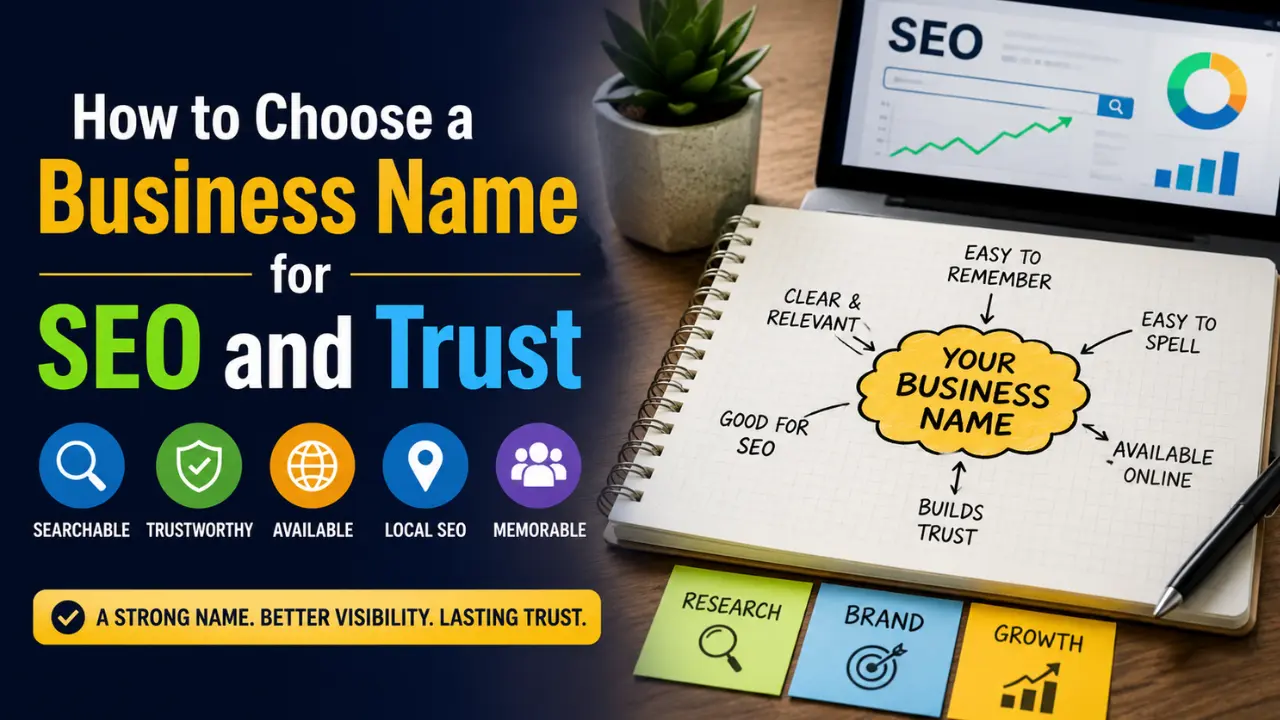

Choosing a business name feels simple until you try to use it online. A name may sound good in your mind, but it also needs to work on Google, social media, business listings, invoices, domain names, and customer searches.
A strong business name does more than identify your company. It helps people remember you, search for you, trust you, and understand what you offer without confusion.
Many small business owners choose names based only on emotion, family meaning, or personal taste. Those things matter, but an online business name also needs clarity, searchability and long-term flexibility.
A Good Business Name Should Be Easy to Understand
A business name should give people a quick idea of who you are or what kind of value you provide. It does not always need to describe the service directly, but it should not create unnecessary confusion.
For example, a name like “BrightPath Accounting” immediately feels connected to finance, guidance, and professional help. A name like “Blue Mango Group” may sound creative, but customers may not understand what the business does unless the branding explains it clearly.
Clarity matters more when you are new
Big companies can use abstract names because they already have brand recognition. A new small business usually does not have that advantage.
When people see your name for the first time, they should not need extra effort to understand whether your business fits their need. Clear naming reduces friction before the customer even visits your website.
Avoid names that sound clever but unclear
A clever name may impress the owner, but it can confuse customers. If people need you to explain the meaning every time, the name may not work well in real-world marketing.
A good test is simple: say the name to someone once and ask what kind of business they think it is. If their answer feels completely unrelated, the name may need improvement.
Before choosing an agency or freelancer, review these essential parts of an ecommerce PPC service so you know what you are actually paying for.
Your Business Name Should Be Easy to Spell and Search
Online discovery depends heavily on spelling. Customers may hear your business name in conversation, see it on a sign, or remember it from a social post. Later, they may search for it on Google.
If the name has unusual spelling, extra letters, hard punctuation, or confusing pronunciation, people may struggle to find you.
Simple spelling helps with repeat searches
A customer who remembers your name but spells it wrong may land on another website, another social profile, or a competitor. That problem becomes worse when your name sounds similar to many other brands.
Names with clean spelling usually perform better for direct search. They also look more professional on invoices, ads, email addresses, and local listings.
Be careful with forced modern spelling
Changing “clean” to “kleen” or “quick” to “qwikk” may look unique, but it can make your brand harder to remember. Creative spelling only works when you have enough marketing power to teach people the name.
For most small businesses, simple beats complicated. A name that people can hear once, spell correctly, and search easily gives you a practical advantage.
Check Whether the Domain Name Makes Sense
A business name should also work as a domain name. Many owners fall in love with a name first and only later realize that the domain is unavailable, expensive, or already used by another company.
Your domain does not always need to match your business name perfectly, but it should feel natural and trustworthy.
Exact-match domains are helpful but not always required
If your business name is “Cedar Lane Cleaning,” a domain like cedarlanecleaning.com works well because it matches the brand directly. If that domain is unavailable, something like cedarlanecleaningco.com may still work.
The problem starts when the domain becomes too long, awkward, or unrelated. A confusing domain makes the business look less professional and harder to remember.
Avoid domains that create trust issues
Be careful with domains full of hyphens, numbers, strange extensions, or words that make the brand look temporary. Customers often judge a business before they even open the website.
A clean domain gives your business a stronger first impression. It also helps when you print the website on cards, signs, packaging, and local ads.
Many small businesses blame the platform, but the real issue often starts with the common reasons ads fail and the solutions behind them.
Think About Google Search Before You Decide
Your business name will become part of your online search identity. Customers may search your exact name, your name plus your city, or your name plus your service.
That means you should check how the name looks in search results before you commit to it.
Search the name in different ways
Before choosing a business name, search it with different combinations:
- The business name alone
- The name plus your city
- The name plus your main service
- The name plus words like “reviews,” “near me,” or “company”
This helps you see whether the name already belongs to another business, sounds too similar to a competitor, or gets buried under unrelated results.
Avoid names already dominated by bigger brands
If a large company, popular app, or national brand already owns the search results for a similar name, your small business may struggle to stand out. Even if your business is different, customers may feel confused.
A name with cleaner search space gives you a better chance to build branded traffic over time. That matters because branded searches often show stronger trust and buying intent.
Make Sure the Name Works for Local SEO
For local businesses, a name should support recognition in your area without creating future limits. A location-based name can help customers understand where you operate, but it can also become restrictive if you expand.
For example, “Austin Lawn Care Pros” works well for a lawn care company focused only on Austin. But if the business later expands to nearby cities, the name may feel too narrow.
Location names can help or hurt
A city or neighborhood name can make sense when your business depends heavily on local searches. It can create instant relevance for people in that area.
However, it may not suit businesses that plan to serve multiple cities, sell online, franchise, or move later. You need to decide whether local clarity matters more than future flexibility.
Service words can add useful clarity
Adding a service word like cleaning, roofing, accounting, design, landscaping, repair, or catering can make the name more understandable. This helps customers and search engines connect your brand with your category.
Still, the name should sound like a real brand, not only a keyword phrase. “Smith Family Roofing” feels more natural than a stuffed name built only for search.
Check Social Media Handle Availability
A business name should also work across social platforms. Even if your website matters most, customers may still check your Facebook page, Instagram profile, LinkedIn page, TikTok account, or YouTube channel.
If your preferred handle is unavailable everywhere, your brand may look scattered online.
Consistency builds trust
A consistent handle makes your business easier to find. It also makes your brand look more established.
For example, if your business uses the same or very similar name across your website, Google Business Profile, Facebook, and Instagram, customers feel more confident that they found the right company.
Do not ignore platforms you do not use yet
You may not need every social platform today, but it still helps to reserve important handles early. This prevents confusion later and protects your brand from copycats or unrelated accounts.
At minimum, check the platforms that matter most for your type of business. A local service business may care more about Google, Facebook, and Instagram, while a B2B service may care more about LinkedIn.
Avoid Names That Box the Business In
A business name should fit today, but it should also leave room for tomorrow. Many owners choose a name based on their first offer, then later regret it when the company grows.
For example, a name like “Quick Logo Studio” may work if you only sell logos. But if you later offer websites, branding, ads, and marketing strategy, the name may feel too small.
Think about future services
Ask yourself whether the name still makes sense if you add new services. A flexible name gives you space to grow without rebranding.
This does not mean your name should become vague. It means the name should describe your direction without trapping you in one tiny offer.
Think about future locations
If your business may expand beyond one city, avoid a name that makes the company sound local-only. If your business will stay local by design, then a location name may still work well.
The best choice depends on your business model, not a universal rule.
A few small changes to your photos, services, reviews and call buttons can help convert Google Profile views into phone calls.
Make the Name Sound Professional in Real Situations
A business name should sound good when customers say it, employees answer calls, and partners see it in writing. Some names look interesting on paper but feel awkward in real use.
Imagine saying the name in these situations:
- “Thank you for calling…”
- “You can visit us at…”
- “The invoice will come from…”
- “Please leave us a review for…”
- “Search us on Google under…”
If the name feels difficult, childish, too long, or hard to pronounce, customers may feel the same.
Shorter names are usually easier to remember
A short name does not automatically mean a better name, but long names often create problems. People may shorten them without permission, spell them differently, or forget parts of the name.
A name with two to four clear words usually works well for many small businesses. The right length depends on the industry, but clarity should guide the decision.
Avoid names that sound too similar to competitors
A name that sounds close to another business can create confusion. It can also make your brand look less original.
Before you decide, compare your name against local competitors and online brands in your category. You want customers to remember you for the right reason.
Check Basic Legal and Registration Issues
A business name may sound available, but that does not mean you can safely use it. You should check business registration databases, local rules, domain use, and trademark conflicts before you build everything around the name.
This step matters because changing a business name later can cost money, time, rankings, reviews, and customer trust.
Business name availability is not the same as trademark safety
A state or local registration may allow a name, but another company may still have stronger rights in a similar name. This becomes more important if you sell across state lines, build a national brand, or operate in a competitive category.
For serious business plans, it is wise to get proper legal guidance before investing heavily in a name.
Do not build your brand before checking
Many owners design logos, buy signs, open social pages, and print materials before doing basic checks. That creates risk.
A better process is to shortlist names first, then check availability, search visibility, domain options, social handles, and possible conflicts before making the final decision.
Test the Name With Real People
A business name should not only sound good to you. It should make sense to the people you want to serve.
Ask a few potential customers, friends, or business contacts what they think the business does based only on the name. Their first reaction can reveal clarity problems quickly.
Ask better questions
Do not only ask, “Do you like this name?” People may say yes to be polite.
Ask questions that reveal usefulness:
- What kind of business do you think this is?
- Is the name easy to remember?
- Is anything confusing about it?
- Would you trust a company with this name?
- How would you spell it after hearing it once?
These answers matter more than compliments.
Do not follow every opinion
Feedback helps, but too many opinions can create confusion. You do not need a name that everyone loves. You need a name that your target customers understand, remember, and trust.
Use feedback to find problems, not to chase perfection.
A Simple Checklist Before You Choose
Before you finalize a business name, review it from a practical online perspective.
A strong name should usually pass these checks:
- It explains or supports the business category clearly.
- It is easy to pronounce, spell, and remember.
- It does not look too similar to a competitor.
- It has a reasonable domain option.
- It works on social media handles.
- It does not limit future growth too much.
- It looks professional on invoices, ads, listings, and signage.
- It has no obvious legal or trademark red flags.
- It makes sense when customers search for it online.
This checklist does not guarantee success, but it reduces avoidable mistakes. A business name should support your marketing, not make every future step harder.
Best Business Name Balances Brand and Search
Some business owners focus only on creativity. Others focus only on keywords. A strong online business name usually balances both.
A purely creative name may feel memorable but unclear. A purely keyword-based name may rank in some searches but feel generic. The best option gives customers a reason to remember you while still making the business easy to understand.
For most small businesses, the right name should feel simple, clear, trustworthy, and usable everywhere. It should work when someone sees it on Google, hears it from a friend, visits the website, or reads it on a business card.
Choosing a business name is not only a branding decision. It is a search, trust and growth decision. When you choose with the online future in mind, your name becomes easier to market, easier to remember, and easier to build into a real business asset.
Frequently Asked Questions
Should my business name match my domain name?
A close match is usually better because it helps customers find you easily. The domain does not need to be perfect, but it should look clean, simple, and connected to your business name.
How do I know if a business name is already taken?
Search the name on Google, check domain availability, look at social media handles, and review business registration or trademark databases where relevant. For serious plans, legal guidance can help reduce risk.
Why does a business name matter for online growth?
Your business name affects branded searches, website trust, social media consistency, local listings, reviews, and customer recall. A weak or confusing name can make marketing harder from the start.

2 thoughts on “How to Choose a Business Name That Works Online”