
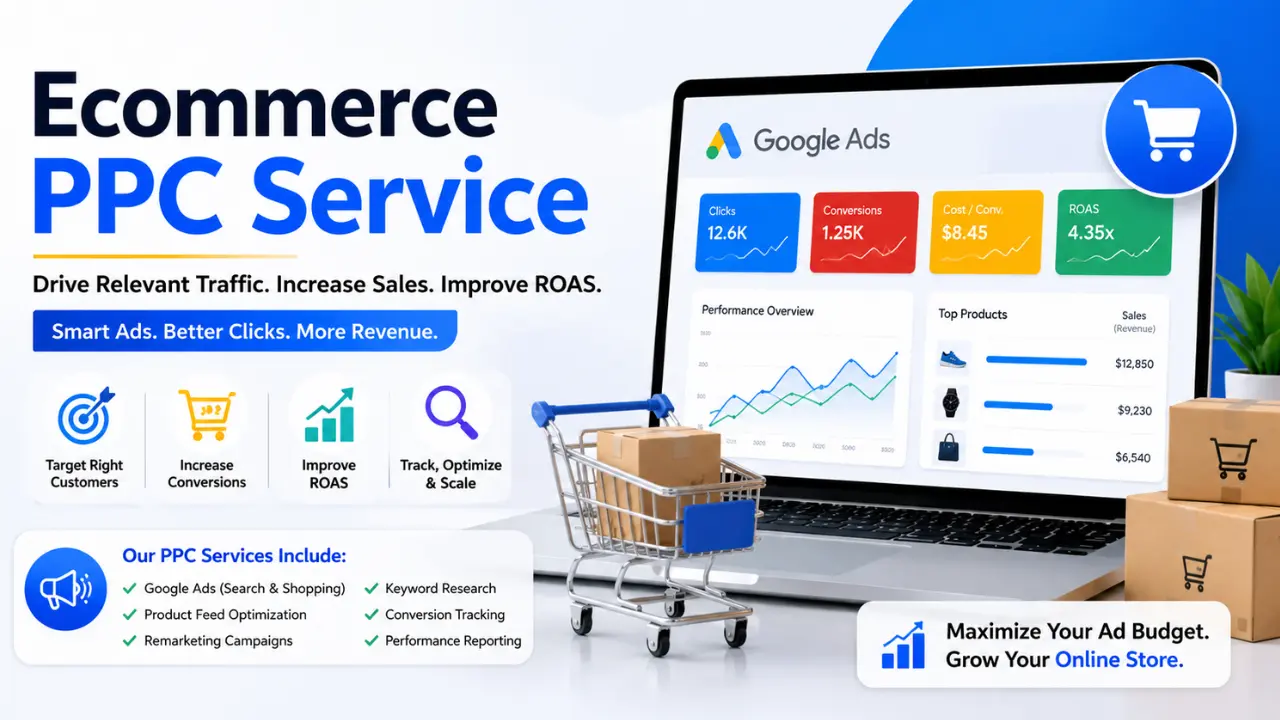

An ecommerce PPC service helps online stores manage paid ads across search engines, shopping ads, remarketing campaigns, and social platforms so they can attract buyers who are already looking for products. For an online store, PPC is not just about getting traffic. It is about sending the right buyer to the right product page at the right cost.
An ecommerce PPC service usually includes ad strategy, product feed review, campaign setup, keyword targeting, shopping ads management, conversion tracking, remarketing, budget control, and ongoing optimization. A good service focuses on sales, profit, return on ad spend, and customer acquisition cost instead of only clicks or impressions.
Many ecommerce store owners start paid ads with a simple goal: get more orders. The problem is that ecommerce advertising becomes expensive very quickly when campaigns are not connected to product margins, website conversion rate, inventory, and buyer intent. A store can receive hundreds of clicks and still lose money if the wrong products are promoted or the landing pages are not ready to convert.
What Is an Ecommerce PPC Service?
An ecommerce PPC service is a paid advertising management service designed specifically for online stores. PPC means pay-per-click, where a business pays when someone clicks on its ad. In ecommerce, these ads often promote product pages, product categories, sale pages, or shopping listings.
Unlike regular lead generation ads, ecommerce PPC is directly tied to products. Each product has a price, margin, stock level, image, title, description, shipping offer, and competitor comparison. That means the advertising strategy must be built around product performance, not just general website traffic.
A proper ecommerce PPC service may manage ads on platforms such as Google Ads, Microsoft Ads, Meta Ads, Pinterest Ads, TikTok Ads, or other paid channels depending on the store’s audience. But the platform is not the main point. The main point is whether the ads are bringing profitable buyers to the store.
For example, a store selling low-margin accessories cannot use the same PPC strategy as a store selling high-ticket furniture or premium skincare products. The service must understand average order value, repeat purchase potential, product profit margin, customer lifetime value, and how much the store can afford to spend to acquire one customer.
If you are new to online ads, this guide on Paid Advertisement on Google: How It Works for Small Businesses can help you understand the foundation before moving into ecommerce PPC.
Why Ecommerce PPC Is Different From Normal PPC
Ecommerce PPC is different because every click is connected to a product decision. A service business may only need one qualified lead to make a campaign profitable. An online store usually needs consistent product purchases, smooth checkout behavior, and enough order value to cover ad cost.
In normal PPC, the advertiser may focus on keywords, form submissions, calls, and appointments. In ecommerce PPC, the advertiser must also focus on product titles, product images, feed quality, price competitiveness, reviews, shipping information, product page speed, checkout trust, and abandoned cart recovery.
This is where many online stores waste money. They treat ecommerce ads like normal website promotion. They send paid traffic to product pages that have weak images, unclear descriptions, missing reviews, poor shipping information, or a slow checkout process. The ad campaign then receives clicks, but the store does not receive enough orders.
A strong ecommerce PPC service looks beyond the ad account. It studies how the store sells. It checks whether the ad promise matches the product page. It identifies which products deserve ad spend and which products should not be promoted yet. This matters because not every product in an online store is ready for paid traffic.
What Should an Ecommerce PPC Service Include?
An ecommerce PPC service should include more than campaign creation. Anyone can launch ads. The value of the service comes from planning, tracking, testing, and improving the campaigns based on real store performance.
Store and Product Audit
Before spending money on ads, the service should review the store’s product pages, categories, pricing, shipping offer, checkout process, and trust signals. This audit helps identify whether the website can convert paid traffic.
If a store has poor product descriptions, unclear return policy, weak images, or no visible customer trust elements, paid ads may expose those problems faster. PPC can bring visitors, but the website must still convince them to buy.
A useful audit should answer practical questions such as:
- Which products have enough margin for paid advertising?
- Which products already receive organic interest or sales?
- Which categories have strong buyer intent?
- Which pages need improvement before ad traffic begins?
- Which products should be excluded from the first campaign?
This step protects the store from spending money on products that are unlikely to convert.
Product Feed Review
For ecommerce PPC, the product feed is extremely important. A product feed contains product names, prices, images, descriptions, availability, brand details, categories, and other product information used by shopping ads and product-based campaigns.
If the feed is weak, the ads may appear for the wrong searches or fail to attract serious buyers. A product title that is too vague can limit visibility. A poor product image can reduce clicks. Missing product details can weaken campaign performance.
An ecommerce PPC service should review the feed and make sure the products are clearly organized. Product titles should describe what the item is, who it is for, and what important details matter to buyers. Product categories should be accurate. Prices and availability should be updated properly.
This is not only a technical task. It is also a sales task. The feed should help the ad platform understand the product and help the buyer understand why the product is relevant.
Campaign Strategy
A good ecommerce PPC service should not create random campaigns for every product. It should build a strategy based on store goals.
Some stores need immediate sales. Some need to promote bestsellers. Some need to clear seasonal inventory. Some need to build brand awareness before buyers convert. Some need remarketing because visitors browse but do not buy on the first visit.
The campaign strategy should define:
- Which products will be promoted first
- Which audience or search intent will be targeted
- Which platforms will be used
- How much budget each campaign receives
- What conversion actions will be measured
- What performance level is considered profitable
Without a clear strategy, PPC becomes a guessing game. The store owner may keep increasing the budget without knowing whether the campaigns are actually improving.
Search and Shopping Ads Setup
Search ads and shopping ads often play an important role in ecommerce PPC. Search ads target people typing specific queries, while shopping ads show product details such as image, price, and store name.
For ecommerce, shopping ads can be powerful because the buyer sees product information before clicking. This can reduce wasted clicks from people who are not interested in the price, style, or product type.
Search ads can also work well when buyers use high-intent phrases. For example, someone searching for a specific product type, size, material, or brand comparison may be closer to buying than someone using a broad informational search.
A PPC service should separate buyer-intent searches from general research searches. Not every keyword deserves paid budget. Some keywords bring visitors who are still learning, while others bring people who are ready to compare and purchase.
Remarketing Campaigns
Many ecommerce visitors do not buy on their first visit. They may compare prices, read reviews, check shipping, wait for payday, or leave the cart unfinished. Remarketing helps bring those visitors back.
An ecommerce PPC service should use remarketing carefully. It can target people who viewed products, added items to cart, visited a category page, or purchased before. The message should match the visitor’s behavior.
For example, someone who abandoned a cart may need a reminder about the product, shipping, or limited stock. Someone who viewed a category page may need a bestsellers ad. A past customer may respond better to related products or repeat purchase offers.
Remarketing should not be aggressive or careless. The goal is to support the buyer journey, not annoy visitors with the same ad everywhere.
How an Ecommerce PPC Service Measures Success
The success of an ecommerce PPC service should not be measured only by clicks. Clicks are useful only when they move the store closer to profitable sales.
A campaign can have a high click-through rate and still fail if visitors do not buy. A campaign can have many impressions and still be weak if the audience is too broad. A campaign can generate sales and still lose money if the cost per purchase is too high compared to the product margin.
The most important ecommerce PPC metrics usually include:
- Revenue: How much sales value came from paid ads.
- ROAS: How much revenue the store earned for each dollar spent on ads.
- Cost per purchase: How much it costs to get one order.
- Conversion rate: How many visitors turned into buyers.
- Average order value: How much customers spend per order.
- Profit margin: Whether the campaign is profitable after product cost, shipping, and ad spend.
- New customer acquisition cost: How much the store spends to gain a new buyer.
A serious ecommerce PPC service should explain these numbers clearly. Store owners should not only receive reports filled with technical metrics. They should understand what is working, what is wasting money, and what changes are being made next.
When Does an Online Store Need Ecommerce PPC Help?
An online store may need an ecommerce PPC service when it has products ready to sell but cannot get enough qualified traffic. PPC can help stores reach buyers faster than organic search alone, especially when the store is new, launching a product, or entering a competitive market.
However, PPC is not always the first step. If the website is unfinished, the checkout does not work smoothly, or product pages are weak, paid ads may increase losses instead of sales.
An ecommerce store is more ready for PPC when it has:
- Clear product pages with strong images and descriptions
- Working checkout and payment system
- Competitive pricing or a clear value reason
- Shipping and return details visible to buyers
- At least a basic understanding of product margins
- Tracking installed to measure purchases
- Enough budget to test campaigns properly
PPC needs data. A very small test budget may not give enough information to make good decisions. That does not mean a store must spend heavily from day one, but it should have a realistic testing budget and patience for optimization.
Common Problems an Ecommerce PPC Service Should Fix
Many ecommerce stores do not fail at PPC because the product is bad. They fail because the campaign structure, tracking, or product selection is wrong.
One common problem is promoting too many products at once. When the budget is spread across hundreds of products, no product gets enough data. A better approach may be to start with the strongest products, best margins, or most proven categories.
Another problem is poor tracking. If purchases, revenue, cart actions, and checkout behavior are not tracked correctly, the service cannot know which campaigns are profitable. Wrong tracking leads to wrong decisions.
A third problem is weak search intent. Broad keywords can attract people who are not ready to buy. Ecommerce PPC works better when ads focus on product-specific intent, comparison intent, brand intent, and shopping behavior.
A fourth problem is ignoring landing pages. Some store owners blame the ads when the real issue is the product page. If buyers click but leave quickly, the product page may not answer their questions or create enough trust.
A fifth problem is chasing revenue without checking profit. A campaign may generate sales, but if the product margin is too low, the store may still lose money. This is why profit-aware PPC management is important for ecommerce.
Ecommerce PPC Service vs Doing PPC Yourself
Some store owners start PPC themselves, especially when the store is small. This can work in the beginning if the budget is limited and the owner wants to understand how paid ads behave. Learning the basics can also help the owner communicate better with an agency or freelancer later.
However, ecommerce PPC becomes more complex as the store grows. More products, more campaigns, more audiences, more tracking issues, and more testing decisions make it harder to manage casually.
Doing PPC yourself may be enough when the store has a small number of products, a small budget, and simple goals. A professional ecommerce PPC service becomes more useful when ad spend increases, product categories expand, sales data becomes harder to read, or the owner cannot identify why campaigns are not profitable.
The decision should not be based only on convenience. It should be based on whether better management can save wasted spend, improve conversion quality, and help the store scale with more control.
How to Choose the Right Ecommerce PPC Service
Choosing the right ecommerce PPC service requires more than checking price. A cheaper service can become expensive if it wastes ad budget. A higher-priced service can also be a poor choice if it does not understand ecommerce profit.
The store owner should ask clear questions before hiring:
- Do you review product margins before choosing products to promote?
- Do you check product feeds and shopping campaign structure?
- How do you track purchases and revenue?
- How do you decide which products deserve more budget?
- Do you report profit-related metrics or only ad metrics?
- How often do you optimize campaigns?
- What do you need from the store owner before starting?
- How do you handle products with low margins or low conversion rates?
The best ecommerce PPC service should be able to explain its process in plain language. If the explanation is only filled with technical terms and unclear promises, the store owner may not know what is actually being done.
A good service should also be honest about timing. PPC can bring data quickly, but profitable scaling usually requires testing. Ads need enough time to identify which products, audiences, messages, and landing pages perform best.
How Much Should an Ecommerce Store Spend on PPC?
There is no single budget that fits every ecommerce store. The right PPC budget depends on product price, profit margin, competition, conversion rate, average order value, and how quickly the store wants to test.
A store selling expensive products may need a higher cost per click but can still be profitable if each order brings strong revenue. A store selling low-cost products may need a lower cost per purchase or a strong repeat purchase model to make ads work.
The service should help the store owner understand the relationship between ad spend and sales economics. For example, if a store sells a $40 product with a small margin, it cannot afford the same customer acquisition cost as a store selling a $500 product with a higher margin.
Instead of asking only, “How much should I spend?” the better question is, “How much can I afford to spend to acquire one customer and still make profit?”
That question creates a healthier PPC strategy because it connects advertising to business reality.
What Store Owners Should Prepare Before Hiring
Before hiring an ecommerce PPC service, store owners should prepare basic information about their business. This helps the service make better decisions from the beginning.
The most useful information includes product margins, best-selling products, average order value, customer location, shipping policy, return policy, seasonal trends, current website traffic, past ad results, and business goals.
Store owners should also decide what they want from PPC. Some want more sales immediately. Some want to grow a new product line. Some want to retarget visitors. Some want to reduce dependence on marketplaces. Some want to build a direct-to-consumer brand.
Clear goals help the PPC service choose the right campaign structure. Without clear goals, the campaigns may appear active but lack direction.

1 thought on “7 Things an Ecommerce PPC Service Should Include”