
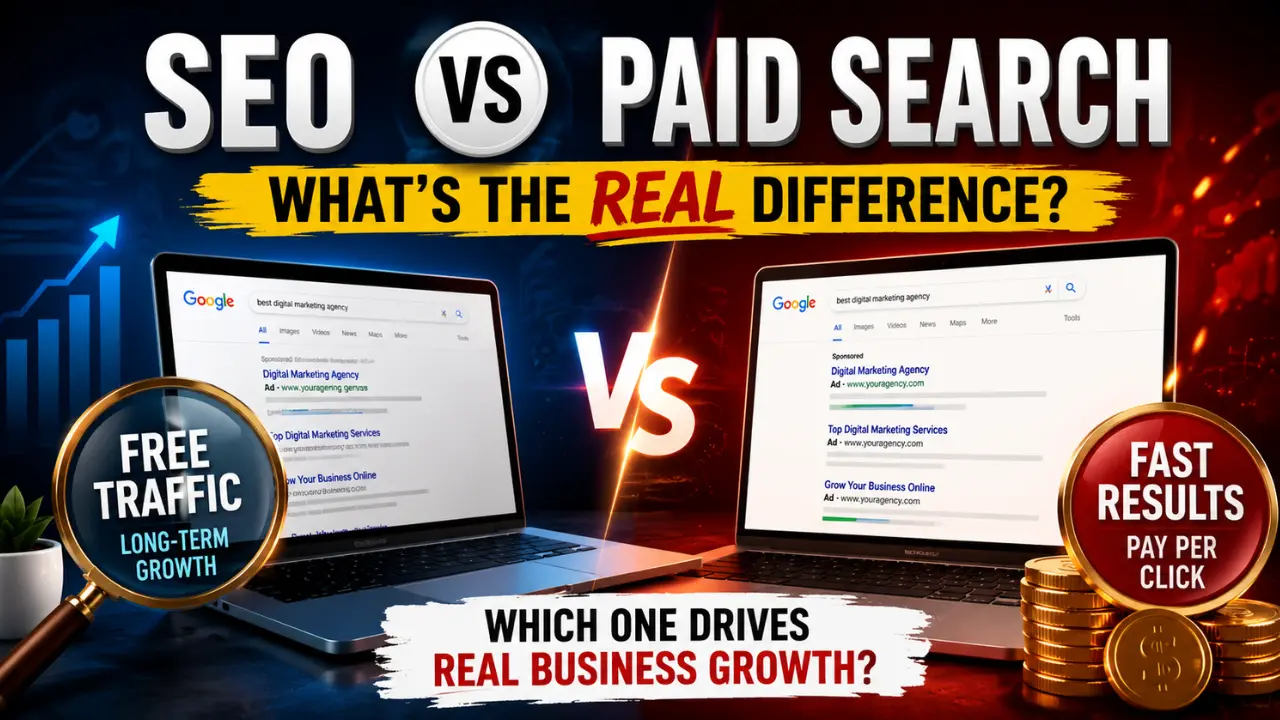

SEO and paid search both help businesses appear in search results but they work through different systems and serve different business purposes.
SEO focuses on earning organic visibility over time. Paid search focuses on buying sponsored visibility through advertising platforms such as Google Ads. One depends more on content quality, website trust, technical strength and long-term authority. The other depends more on campaign setup, keyword targeting, bidding, landing pages and advertising budget.
The difference is not simply “free traffic versus paid traffic.” That explanation is too shallow. The real difference is how each channel attracts customers, how quickly it can work, how much control the business has, how costs behave and how sustainable the traffic becomes over time.
Also Read: How Paid Visibility Works on Google Search
The Simple Difference
SEO is organic search visibility. When a page ranks naturally in Google, the business does not pay Google for each click. The traffic is earned through relevance, usefulness, technical quality, authority and how well the page satisfies search intent.
Paid search is sponsored search visibility. A business creates ads, chooses keywords or targeting, sets a budget and pays when people click or interact with those ads. Paid search can create visibility much faster than SEO but that visibility depends on active spending and campaign performance.
| SEO | Paid Search |
|---|---|
| Earned organic visibility | Purchased sponsored visibility |
| Usually slower to build | Can create visibility faster |
| No direct payment per organic click | Usually pay per click |
| Depends on content, authority, and technical quality | Depends on targeting, bids, ads, and landing pages |
| Can keep bringing traffic over time | Usually stops when budget stops |
| Strong for long-term visibility | Strong for immediate demand capture |
This table gives the basic distinction but the deeper difference becomes clearer when you look at how both channels behave in real business growth.
How SEO Works in Real Business Growth
SEO works by helping a website become more useful, trustworthy and relevant for the searches a business wants to appear for. It includes content quality, site structure, technical optimization, internal linking, user experience, local relevance and authority signals.
For a business, SEO is rarely about ranking one page alone. It is usually about building a wider search presence over time. A service page may target commercial searches. A guide may answer informational searches. A comparison article may help users evaluate options. A local landing page may support city-based visibility. Together, these pages help search engines understand what the business offers and why it deserves visibility for related searches.
SEO Depends on Relevance and Authority
Search engines try to show results that satisfy the searcher. That means SEO has to prove relevance at the page level and authority at the website level. A page should answer the search clearly but the broader website also needs to show depth, structure, consistency and trust around the subject.
For example, a website about paid advertising may not become highly trusted from one basic article alone. It becomes stronger when it consistently covers related areas such as campaign setup, keyword targeting, landing pages, conversion tracking, bidding strategy and advertising mistakes. That broader topical depth helps search engines understand the website’s expertise.
Why SEO Usually Takes Longer
SEO usually takes longer because organic visibility is earned gradually. Search engines need time to discover the page, crawl the content, understand the topic, compare it with competing pages and decide whether it deserves to rank.
Even after a page ranks, visibility can still change. Competitors may improve their content, search intent may shift, algorithms may update and newer pages may enter the results. This makes SEO less immediate than paid search, especially in competitive industries.
The strength of SEO is that it can become more stable over time when the website keeps improving. The weakness is that businesses often need patience before organic results become meaningful.
Why Organic Visibility Can Compound
SEO can compound because strong pages may continue bringing traffic long after publication. A helpful service page, comparison guide or evergreen article can keep attracting visitors if it remains accurate, useful and aligned with search intent.
Over time, a website can also build topical authority. This means search engines may begin to understand that the site consistently covers a subject well. That does not guarantee rankings but it can improve the website’s ability to compete across related searches.
How Paid Search Works in Customer Acquisition
Paid search works by placing ads in front of people searching for selected keywords. Instead of waiting for organic rankings to develop, the business pays for the chance to appear in sponsored results.
For example, a local repair business may run ads for “emergency plumber near me.” A law firm may advertise for “personal injury lawyer consultation.” A roofing company may bid on “roof leak repair estimate.” These searches often show strong commercial intent because the user is already looking for a provider, price, quote, appointment or solution.
Paid Search Targets Existing Demand
Paid search is often useful when demand already exists. The searcher has typed something into Google that reveals a need, problem or buying intent. The advertiser is not waiting for an organic ranking to develop; the advertiser is paying to appear during that moment.
This is why paid search can work well for urgent local services, appointment-based businesses, high-value leads and competitive commercial keywords. The channel gives the business more control over which searches it wants to compete for.
Fast Visibility Does Not Guarantee Profitability
Paid search can work quickly but it is not automatically profitable. A campaign still needs the right keywords, competitive bids, relevant ad copy, proper location targeting, a strong landing page and accurate conversion tracking.
This is where many businesses misunderstand paid search. They think they are buying customers but they are really buying access to search traffic. The campaign still has to convert that traffic into calls, forms, bookings, purchases or qualified inquiries.
If campaign setup is weak, paid search can spend money without producing useful results. Traffic may arrive but it may not have the right intent, trust level or landing page experience to become a customer.
Why Paid Search Costs Differ by Industry
Paid search costs vary because competition and customer value vary. Legal services, insurance, finance, home services and B2B software often have expensive clicks because one customer can be valuable.
This changes how businesses should think about paid search. The goal is not simply to buy as much traffic as possible. The goal is to buy relevant traffic at a cost that still makes sense after conversion rate, lead quality and customer value are considered.
The Main Difference Is Time, Control and Cost
The clearest business difference between SEO and paid search comes down to time, control and cost.
SEO usually requires more time because trust and authority must be built. It may take months for a new page or website to gain meaningful rankings. But once SEO starts working, it can bring recurring traffic without paying for every click directly.
Paid search usually gives more immediate control. A campaign can be launched, adjusted, paused, expanded or narrowed much faster than SEO. A business can test a keyword, location, offer or landing page quickly. But that control comes with direct cost. Every weak click can waste money if the campaign is not managed carefully.
SEO Builds Gradually
SEO is usually better for long-term search strength. It helps a business build organic visibility that can continue working even when no ad is running.
This makes SEO valuable for businesses that want sustainable search presence, educational visibility, and lower long-term dependence on paid traffic. The trade-off is that early growth can be slow, especially when the website is new or competition is strong.
Paid Search Gives Faster Control
Paid search is usually better for immediate visibility and controlled demand capture. It is useful when the business needs leads quickly, wants to test demand or needs visibility for high-value keywords where organic rankings are not strong yet.
Neither channel is automatically better. The right choice depends on what the business needs now and what it is trying to build over time.
Search Intent Is Where the Difference Becomes Practical
Search intent is one of the most important differences between SEO and paid search.
SEO can support many types of searches. Some people search for information, some compare options, some look for local businesses and some are ready to buy. SEO can serve all of these stages with different types of content.
Paid search usually works better when the searcher is closer to action. Since every paid click has a cost, the campaign usually needs tighter focus on searches that can realistically produce business value.
Informational Searches Often Fit SEO Better
A search like “how does air conditioning work” may be useful for SEO because it can educate users and build topical authority. The searcher may not be ready to hire a repair company immediately but the content can still build trust, support internal linking and introduce the business to future customers.
SEO can handle this broader informational layer because the business is not paying directly for every click. Informational traffic may still support awareness, brand familiarity and long-term search authority.
High-Intent Searches Often Fit Paid Search Better
Paid search usually works better when the searcher is closer to action. A phrase like “24 hour AC repair near me” has stronger commercial intent. The person may need help soon and paying for that click can make sense if the landing page and service offer are strong.
This is why low-intent traffic is more dangerous in paid search. In SEO, informational traffic may still support awareness and long-term trust. In paid search, each click costs money, so the campaign needs stronger commercial focus.
When SEO Makes More Sense
SEO usually makes more sense when a business wants to build long-term visibility and reduce dependence on advertising over time. It is especially useful when customers research before buying, compare options, ask recurring questions or need education before making a decision.
A financial advisor, software company, clinic, home service provider, legal website or business blog can use SEO to answer customer questions and gradually attract relevant search traffic. For local businesses, SEO can also support Google Maps visibility, service pages, local landing pages and trust-building content.
SEO Supports Long-Term Discovery
SEO works well when the business can build topical authority over time. A company that consistently publishes useful content, improves its service pages, maintains technical quality and updates older pages can gradually create a stronger organic footprint.
That kind of visibility can support customers at multiple stages of the decision process. Some users may discover the business through educational content, while others may arrive through service pages when they are ready to act.
SEO Requires Consistency
SEO needs consistent investment in content quality, technical maintenance, internal linking, updates and ongoing optimization. Businesses that improve these areas steadily often build stronger long-term organic visibility.
If the business cannot invest time or resources consistently, SEO may grow slowly. The channel is powerful but it is not passive.
When Paid Search Makes More Sense
Paid search usually makes more sense when the business needs visibility sooner or wants more control over which searches it appears for. It is useful for urgent services, high-value leads, seasonal offers, new locations, product launches and competitive keywords where organic rankings are not strong yet.
A new dental clinic may use paid search to generate appointment requests while SEO is still developing. A roofing company may run ads during storm season. A software company may test which keywords bring demo requests before investing heavily in long-term SEO content.
Paid Search Supports Immediate Demand
Paid search supports immediate demand because it allows the business to appear for selected searches without waiting for organic rankings. This is helpful when customer acquisition cannot wait for SEO to mature.
It also allows more controlled testing. If a keyword produces profitable leads through ads, the business may later build SEO pages around that same topic. If a landing page fails in paid search, the business can improve the offer or page before relying on it for organic traffic.
Paid Search Requires Cost Control
Paid search needs tracking, landing page quality, keyword discipline and regular optimization. Without those, it can become expensive quickly.
The channel gives more control than SEO in the short term but that control only helps when the business monitors cost per lead, conversion rate, search term quality and return on ad spend.
How SEO and Paid Search Work Together
The strongest search strategies often use SEO and paid search together.
Paid search can create faster visibility while SEO is still growing. It can also reveal which keywords, offers and landing pages produce real business value. That information can guide SEO decisions more intelligently.
SEO can support paid search by improving landing pages, strengthening brand trust and building content around the questions users ask before they convert. A business with strong organic presence may also rely less heavily on ads for every customer, which can reduce long-term pressure on advertising spend.
Example of Both Channels Working Together
An HVAC company may use paid search for urgent terms like “emergency AC repair near me” while building SEO pages for AC repair, AC maintenance, energy-saving tips and local service areas.
Paid search captures immediate demand. SEO builds wider search presence over time. This combination is often stronger than depending completely on one channel.
Common Mistakes Businesses Make
Many businesses misunderstand SEO and paid search because they judge both channels only by traffic.
Traffic matters, but traffic alone does not prove success. A business needs the right traffic, from the right search intent, moving toward the right action.
Common SEO and Paid Search Mistakes
| Mistake | Why It Hurts |
|---|---|
| Expecting SEO to work immediately | Organic visibility usually needs time, authority and content depth |
| Treating paid search as guaranteed leads | Ads still need strong targeting, landing pages and tracking |
| Paying for broad low-intent clicks | Budget can be spent on users unlikely to convert |
| Ignoring SEO because ads are running | Long-term organic visibility becomes weaker |
| Ignoring paid search completely | Immediate high-intent demand may be missed |
| Measuring only clicks or traffic | Lead quality, conversion value and customer acquisition matter more |
Better Way to Judge Both Channels
A better approach is to judge both channels by business value. SEO should be measured by rankings, organic traffic, qualified visitors, leads and long-term growth. Paid search should be measured by cost per lead, conversion rate, search term quality, landing page performance and return on spend.
Businesses often get stronger results when SEO and paid search are treated as complementary systems rather than competing choices. SEO can build durable search visibility, while paid search can provide faster demand capture and useful market testing. The right balance depends on the business stage, competition level, budget, customer value and how quickly leads or sales are needed.

1 thought on “What’s the Difference Between SEO and Paid Search?”