
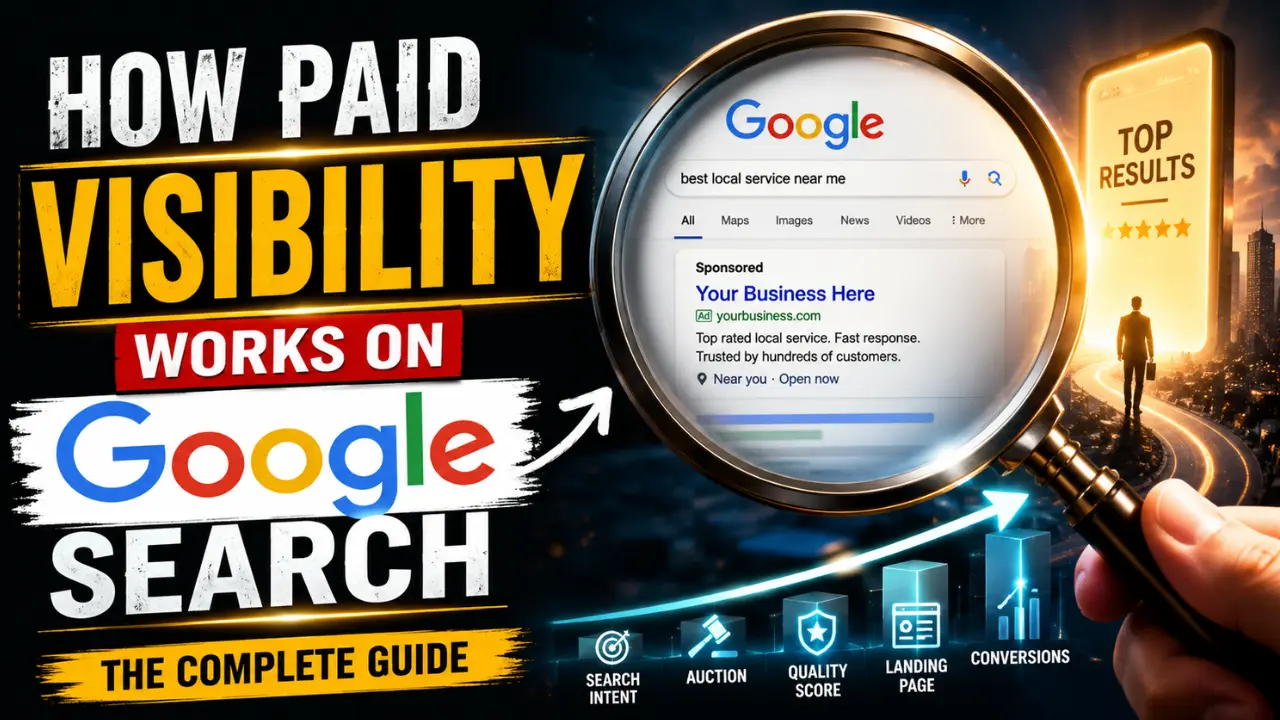

Most businesses understand that Google Ads can place a company above organic search results but many do not understand what actually controls that visibility once a campaign enters Google’s system. Paid visibility on Google Search is not a simple transaction where a business pays money, receives a top position and automatically gets customers. It works more like a live competitive marketplace where search intent, bid strategy, campaign quality, customer behaviour, landing page experience and conversion data all influence who gets seen and how efficiently that visibility turns into revenue.
This is why two businesses can advertise for the same keyword and get completely different outcomes. One business may spend heavily and receive expensive clicks that rarely convert, while another business with a smaller budget may generate stronger leads because its campaign is better aligned with what the searcher actually wants. The difference is not always budget. Often, the difference is relevance, structure, trust and the quality of the experience after the click.
Google does not only want to show ads because advertisers are willing to pay. Google wants paid results to feel useful enough that users continue trusting the search experience. If people repeatedly click ads that lead to irrelevant pages, confusing offers, slow websites or poor customer experiences, trust in Google Search weakens. That is why paid visibility is partly bought through bidding and partly earned through quality, especially when [landing page experience and search intent alignment directly influence Google Ads performance — Why Businesses With Better User Experience Often Outperform Higher-Spending Competitors].
1. Paid Ads Depend on Search Intent
The foundation of Google Search advertising is intent. A person sees a search ad because they typed something into Google. That search may reveal a problem, a need, a comparison, a question or a buying decision. This makes Google Search different from many other advertising channels, where businesses interrupt people while they are scrolling, watching or reading something unrelated.
On Google, the customer often begins the interaction. Someone searching “emergency plumber near me” is not casually browsing. That person may have an urgent problem and needs help quickly. Someone searching “best accountant for small business taxes” is probably comparing service providers. Someone searching “buy ergonomic office chair online” is much closer to purchase than someone reading a general article about posture.
This is what makes paid visibility on Google valuable. The business is not always trying to create demand from zero. It is appearing when demand has already been expressed.
Click Value Depends on Intent
Not all searches have the same value. A search like “what causes roof leaks” may be useful for education but it does not always mean the person is ready to hire a roofer. A search like “emergency roof leak repair near me” is much closer to action because the user has a specific problem, a location need and probably urgency.
This difference matters because paid visibility is not about getting clicks for the sake of clicks. It is about getting clicks from people who are likely to become customers. A broad keyword may bring more traffic but much of that traffic may come from people who are only researching, looking for free information, comparing casually or not ready to buy. A narrower keyword may bring fewer visitors, but those visitors may be more serious and more valuable. This is why experienced advertisers focus heavily on [high-intent keywords that signal immediate buying or service demand — How Search Intent Determines the Real Value of Google Ads Traffic].
In paid search, traffic quality matters more than traffic volume. A small number of high-intent visitors can produce more revenue than a large number of weak-intent visitors.
Strong Intent Drives Competition
Searches with strong buying intent usually become more expensive because many advertisers want the same customer. Legal services, insurance, finance, home repair, medical services, software and high-ticket local services often have higher click costs because one successful conversion can be worth a lot of money.
This is why cost per click should not be judged in isolation. A $40 click may look expensive but it can be profitable if it creates a $4,000 client. A $2 click may look cheap but it is wasteful if the person never converts. Paid visibility should be judged by customer value, closing rate, profit margin and lead quality, not by click price alone.
A business that understands intent does not simply ask, “How many clicks can we get?” It asks, “Which searches are most likely to produce profitable customers?”
2. Live Auctions Shape Google Ads
Google Ads does not sell fixed positions permanently. Every time someone searches, Google runs a fresh auction. That auction decides which ads are eligible to appear, where they appear and how competitive each advertiser is for that specific search.
This happens instantly but the system behind it is not simple. Google looks at how much the advertiser is willing to pay but it also evaluates how useful the ad experience is likely to be. The system considers whether the ad matches the query, whether users are likely to click, whether the landing page is relevant and whether the visitor is likely to have a good experience after clicking.
This is why the highest bidder does not automatically win the best visibility in the most efficient way. A business may bid aggressively but still struggle if its campaign feels generic, its landing page is weak or its message does not match the searcher’s need. This is one reason [Google Ads quality score and landing page relevance influence ad visibility more than many advertisers expect — Why Better Ad Experience Can Reduce Google Ads Costs].
Better Ads Earn Better Visibility
A budget allows a business to enter the auction, but relevance helps the business compete efficiently. Many small businesses misunderstand this. They see a competitor above them and assume the competitor is simply spending more. Sometimes that is true but often the competitor may also have better campaign structure, stronger landing pages, clearer offers, better reviews, more useful ad copy and cleaner tracking.
Google wants paid results to feel helpful. If a user searches “same day emergency dentist,” the strongest ad experience is not just the one with the largest bid. It is the one that proves emergency availability, location relevance, quick contact, trust and booking convenience.
A generic dental homepage may technically be related but it does not satisfy the urgent search as well as a dedicated emergency dental page. The more directly the ad and page answer the user’s need, the stronger the paid visibility system becomes.
Context Influences Ad Auctions
Paid visibility changes by search phrase, location, device, time, competition and user behaviour. A campaign may perform well in one city but poorly in another. It may convert better on mobile than desktop. It may produce stronger leads during business hours and weaker inquiries late at night.
This is why Google Ads should not be treated as a set-and-forget tool. Paid visibility is dynamic. Competitors change bids, users search differently, seasonal demand rises and falls and Google’s system keeps learning from new data.
A strong advertiser does not only increase budget. It studies patterns. Sometimes the right improvement is narrowing locations, adjusting ad schedules, improving mobile pages, refining keywords, excluding poor-fit searches or changing the offer.
3. Quality Score Affects Costs
Ad Rank is the system Google uses to decide whether an ad appears and how prominently it appears. Quality Score helps Google estimate how relevant and useful the campaign experience is likely to be for users. Together, these systems help determine how efficiently an advertiser competes inside the auction.
This is why Google Ads is not simply a spending race. A business can improve visibility not only by increasing bids but also by improving campaign quality. Better ad copy, clearer keyword alignment, stronger landing pages, faster mobile usability and more useful customer experiences can all improve efficiency.
Relevant Ads Perform Better
Google tries to predict whether users are likely to engage positively with an ad. If an advertisement feels vague or disconnected from the search, users ignore it. If it feels highly relevant and specific, engagement usually improves.
For example, an ad saying “Professional Services Available” gives the searcher very little useful information. An ad saying “Same-Day Water Heater Repair in Phoenix” immediately communicates urgency, location and service relevance.
This matters because searchers move quickly. They scan results rapidly and choose the option that appears most aligned with their immediate need. Businesses that improve [ad copy relevance and keyword-specific messaging in Google Ads campaigns — Why Highly Specific Ads Usually Generate Better Click-Through Rates] often gain stronger engagement because the ad feels directly connected to the searcher’s problem.
Alignment Reduces Waste
A strong campaign creates continuity between the keyword, the advertisement and the landing page. The search expresses a need. The ad confirms the solution. The landing page continues the same promise and makes action easy.
If someone searches “tax accountant for freelancers,” the user expects messaging connected to freelancer taxes, deductions, filing help and self-employed income issues. A generic accounting page may technically relate to the keyword but it creates weaker confidence because the message feels broad instead of targeted.
This kind of alignment reduces wasted clicks because the user immediately feels understood. It also helps Google identify the campaign as a stronger fit for that type of search.
Weak Quality Increases Costs
Many businesses unknowingly create expensive campaigns because their structure is weak. Common problems include broad keywords, generic ads, poor mobile usability, thin landing pages, weak trust signals, unclear calls-to-action and missing conversion tracking.
A weak campaign may still generate clicks but those clicks become expensive because the system predicts lower engagement quality and weaker customer satisfaction. Users click, feel uncertain, leave quickly or contact the business without serious buying intent.
This is why increasing budget alone often fails. If the structure is weak, more spending only scales the inefficiency.
4. Visibility Depends on Match Types
Keywords decide when an ad becomes eligible to appear but match types decide how loosely or tightly Google connects those keywords to real searches. This is where many small businesses lose money because their ads appear for searches that are related in language but unrelated in business value.
A keyword is not the same thing as a customer. It is only a doorway into the campaign. If that doorway becomes too wide, many poor-fit users can enter.
Broad Match Can Waste Budget
Broad match can help discover new opportunities, but it can also stretch visibility too far when campaigns are not carefully controlled. A plumber targeting broad plumbing terms may appear for plumbing jobs, plumbing courses, plumbing salary searches, DIY plumbing repair or plumbing tools.
The same problem appears in many industries. A lawyer may attract searches related to legal jobs or free templates. A consultant may attract people looking for training courses instead of paid services. A premium business may attract bargain hunters who never intended to buy quality work.
The campaign looks active because impressions and clicks exist but the traffic quality remains weak.
Tighter Targeting Reduces Waste
Phrase-style and more restrictive matching approaches help keep visibility closer to the intended search meaning. They do not remove all waste but they reduce unnecessary looseness.
For small businesses with limited budgets, control often matters more than reach. It is usually more profitable to appear for fewer qualified searches than to chase maximum exposure across weak-intent traffic.
Not All Visibility Is Valuable
One of the most valuable habits in Google Ads management is reviewing the real search terms that triggered ads. Businesses often assume their keywords are reaching the right audience but search term reports may reveal something very different.
A campaign targeting “small business accountant” may attract searches for accounting software, accounting jobs, accounting courses, invoice templates or tax calculators. Those searches may relate to accounting in general but they do not necessarily relate to hiring an accountant.
This is where advertisers discover the difference between traffic activity and profitable visibility.
5. Negative Keywords Protect Ad Spend
Negative keywords stop ads from appearing for searches that are unlikely to create value. Many advertisers focus heavily on what they want to target but profitable campaigns also define what they want to avoid.
This matters because Google charges for clicks, not for customer quality. If the wrong user clicks, the business still pays.
Negative Keywords Filter Waste
Negative keywords do more than reduce wasted spend. They shape the type of user entering the campaign. Without proper filtering, campaigns may attract people who click frequently but rarely become profitable customers.
A law firm may receive traffic from users searching for free legal advice, legal jobs or downloadable templates. A renovation company may attract people searching only for the cheapest contractors available. A software business may attract users looking for cracked versions or free alternatives.
The campaign may appear busy but the business pipeline gradually fills with weak leads that waste sales time and distort performance data. This is why experienced advertisers treat [negative keyword strategy as a core part of improving lead quality in Google Ads — How Poor-Fit Searches Quietly Waste PPC Budgets] as an ongoing optimization process rather than a one-time setup task.
Poor Filters Lead to Worse Results
Modern Google Ads systems learn from engagement and conversion patterns. If low-quality searches continue generating clicks or shallow conversions, the system may keep expanding toward similar traffic patterns because it believes those users are valuable.
Over time, the campaign becomes less efficient not because Google Ads stopped working but because the campaign trained the system toward weak commercial intent.
This is why negative keyword work should continue regularly. Strong advertisers constantly remove poor-fit searches so the campaign learns from better traffic over time.
6. Revenue Depends on Landing Pages
The advertisement creates the click but the landing page often decides whether that click becomes revenue. This is one of the biggest reasons Google Ads campaigns fail. Businesses pay for attention but the page after the click does not build enough trust, clarity or momentum to turn the visitor into a customer.
A strong landing page does not simply describe the company. It answers the specific reason the person searched.
If someone searches “emergency AC repair near me,” the page should immediately show emergency availability, service areas, contact options, response expectations, reviews and reassurance. If the visitor instead lands on a broad homepage with generic information, the user may leave before finding what matters. This is the same problem many local service companies face when [emergency-service search traffic lands on general business pages instead of dedicated repair pages — Why High-Urgency Google Ads Visitors Leave Without Converting].
Message Match Builds Trust Quickly
The landing page should continue the same promise made by the keyword and the advertisement. When the search, ad, and page all speak the same language, users feel they reached the right place.
This is especially important for high-intent searches because users are often impatient. Someone searching “same day appliance repair” does not want to navigate through unrelated pages trying to confirm whether the business actually offers same-day service.
The more thinking, searching or interpretation the visitor must do, the more likely the visitor is to leave.
Trust Signals Build Confidence
Paid traffic usually arrives cold. The visitor may know nothing about the business. That means the landing page must establish trust quickly.
Useful trust signals include:
- reviews,
- ratings,
- real customer photos,
- certifications,
- guarantees,
- business location details,
- transparent process explanations,
- service areas,
- response times,
- and visible contact methods.
Without trust signals, many users return to Google and compare competitors instead.
Bad Mobile UX Hurts Revenue
Many Google Ads clicks happen on mobile devices, especially in local service industries. A slow-loading mobile page, confusing form, hidden phone number, intrusive popup or tiny buttons can quietly destroy campaign performance.
This is not only a design issue. It is a profitability issue. Every paid click landing on a frustrating mobile experience becomes a potential customer opportunity lost.
7. Conversion Data Trains the Algorithm
Google Ads cannot optimize effectively if the business does not define success clearly. Clicks are not success. Impressions are not success. Even leads are not always equal.
A business may want phone calls, purchases, quote requests, booked appointments, downloads or qualified sales conversations. If those outcomes are not tracked correctly, the campaign may optimize toward the wrong behaviour.
Weak Tracking Hurts Optimization
Without accurate conversion tracking, businesses often judge campaigns using surface-level numbers such as clicks, impressions or average CPC. Those numbers can be misleading.
A campaign may produce large amounts of traffic but very little revenue. Another campaign may generate fewer clicks while producing much stronger customers. Without tracking, the business cannot clearly see which keywords, ads, locations, devices and landing pages are actually generating value.
This often leads to poor decisions. Businesses may pause profitable keywords because they appear expensive or continue funding wasteful traffic because it produces cheap clicks. This is one reason many advertisers struggle with [Google Ads campaigns that generate activity metrics but fail to reveal real customer profitability — Why Conversion Tracking Matters More Than Click Volume].
Automation Needs Reliable Data
Modern Google Ads uses automation heavily. Smart bidding systems and machine learning models rely on conversion signals to understand which users are valuable.
But automation can only optimize toward the information it receives.
If every form submission is treated equally, Google may continue finding low-quality leads because the system believes those conversions are successful. If phone calls are not tracked, valuable mobile searches may become undervalued. If ecommerce purchase values are missing, the campaign may struggle to distinguish between low-value and high-value customers.
Clean tracking helps the system understand what real business success looks like.
8. Ad Performance Changes With Time
One of the biggest mistakes businesses make is assuming Google Ads performance should remain stable once a campaign begins working. Paid visibility changes constantly because the environment itself changes.
Competitors adjust bids. New advertisers enter the market. Search behaviour evolves. Seasonal demand shifts. Costs rise. Google’s automation learns from new data. User expectations change.
This means a campaign performing strongly today may behave differently several months later even if the business changes nothing internally.
Competition Influences Ad Efficiency
A keyword that once generated affordable leads may slowly become more expensive as competitors improve their campaigns. They may strengthen landing pages, increase budgets, improve offers, collect better reviews or optimize conversion tracking more effectively.
This type of change often happens gradually rather than suddenly. Many businesses eventually feel that Google Ads became “too expensive,” when the deeper reality is that the competitive market became stronger over time.
User Behaviour Changes Seasonally
Search demand changes because people change. Weather, seasons, holidays, economic conditions, trends and local events all influence search behaviour.
Home repair searches may rise after storms. Tax-related searches increase during filing periods. Fitness-related searches often surge near New Year. Ecommerce demand shifts during holidays and promotional seasons.
Even the language people use evolves. Searchers may begin using newer product terms, more specific phrases or different ways of describing problems.
Strong advertisers adapt to these changes instead of relying on outdated assumptions.
Automation Learns From New Signals
Google’s systems constantly learn from engagement and conversion behaviour. This can improve campaigns when the incoming data is strong but it can also weaken campaigns when the system receives poor-quality signals.
If low-quality leads continue getting counted as successful conversions, Google may keep expanding visibility toward similar users because the system believes those users are valuable.
This is why strong advertisers continuously:
- remove poor-fit search terms,
- improve landing pages,
- refine targeting,
- strengthen conversion tracking,
- update messaging,
- and evaluate lead quality.
Paid visibility requires ongoing refinement because the system itself keeps evolving.
9. Visibility and Profit Are Different
Appearing on Google and receiving clicks is not the same thing as generating profitable business growth. Paid visibility only becomes valuable when the entire system works together.
The keyword must attract the right intent. The advertisement must pre-qualify the visitor. The landing page must create trust. The business must respond effectively. The customer value must justify the advertising cost.
If one part breaks, the campaign may look active while quietly losing money.
Traffic Alone Can Be Misleading
A campaign may generate steady traffic and even regular leads while still failing financially if the leads are weak, the close rate is poor or the customer value is too low.
This is why businesses must measure more than clicks. Important metrics include:
- cost per lead,
- lead quality,
- close rate,
- average order value,
- profit margin,
- repeat customer value,
- and lifetime customer value.
Paid visibility should ultimately be judged by whether it creates profitable customer acquisition, not simply by whether it produces activity. Businesses that focus on [why profitable Google Ads campaigns depend on customer value and lead quality instead of traffic volume alone — The Difference Between PPC Activity and Real Business Growth] usually make far better long-term advertising decisions.
Efficient Businesses Win More
Google Ads works best when the business already has strong trust infrastructure. Good reviews, clear positioning, professional branding, useful website content, fast response times and strong customer experience all improve the value of paid traffic.
Ads can bring visitors to the business but they cannot fully compensate for weak trust. If users click and encounter poor reviews, unclear offers, slow pages or weak credibility, many leave and continue comparing alternatives.
This is why paid search is deeply connected to overall business quality. The stronger the business appears after the click, the more efficiently paid visibility can become revenue.
10. Thinking Smarter About Paid Search
Small businesses should not treat Google Ads as a magic traffic machine. It is better understood as a controlled visibility system that buys access to search intent.
The goal is not to appear for every possible keyword. The goal is to appear for searches where the business has a realistic chance of turning attention into profitable customer action.
Start With Intent Before Budget
Before increasing spend, businesses should identify which searches show real buying intent. Informational keywords, comparison keywords and transactional keywords usually require different expectations, messaging and landing pages.
Starting with intent prevents the campaign from chasing traffic that looks impressive but converts poorly.
Scale What Converts Well First
Many businesses scale campaigns before fixing the page users land on. That is backwards. A weak landing page makes every click less valuable.
Before increasing budget, the business should ensure the landing page:
- loads quickly,
- matches the search,
- explains the offer clearly,
- reduces friction,
- displays trust signals,
- and makes the next step obvious.
Use Data to Improve Continuously
Strong Google Ads campaigns improve over time because advertisers learn from data. Search terms reveal waste. Conversion tracking reveals value. Landing page behaviour reveals friction. Lead quality reveals which keywords attract better customers.
Paid visibility becomes more effective when businesses treat Google Ads as an ongoing learning system rather than a one-time traffic purchase.
Why Google Paid Search Is Different
Paid visibility on Google Search works because it connects businesses with people who are already searching for something. But the system does not reward spending alone. It rewards advertisers that understand intent, structure campaigns carefully, create relevant experiences, remove waste, track meaningful outcomes and build trust after the click.
The businesses that succeed with Google Ads are usually not the ones blindly spending the most money. They are the ones creating the smoothest connection between the search query, the advertisement, the landing page, the customer experience and the final business outcome.
That is how paid visibility really works on Google Search. It is not simply buying traffic. It is buying access to intent and then proving, through relevance and experience, that the business deserves the customer’s next click.

1 thought on “How Paid Visibility Works on Google Search”